
James Gregory (mathematician)
Scottish mathematician and astronomer; described an early practical design for the reflecting telescope – the Gregorian telescope.
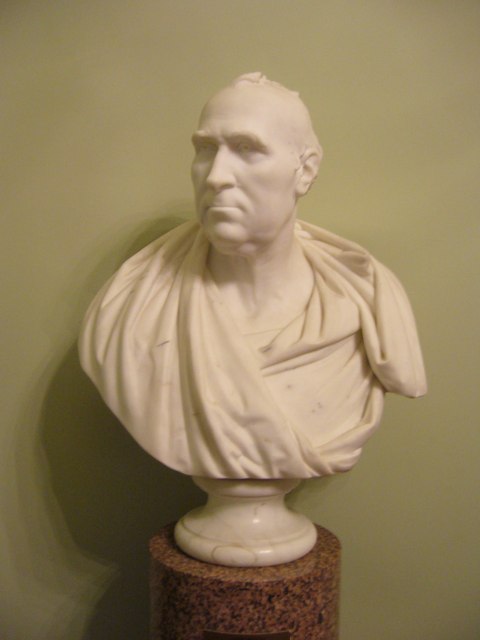
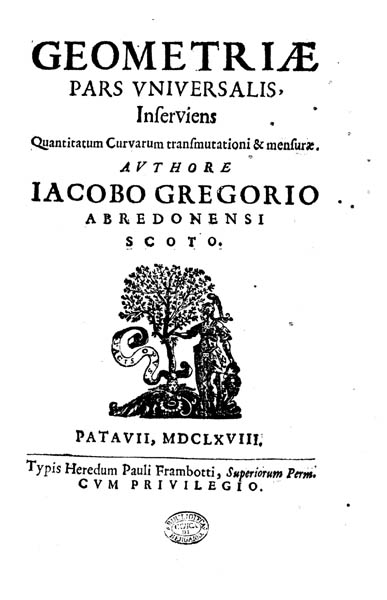
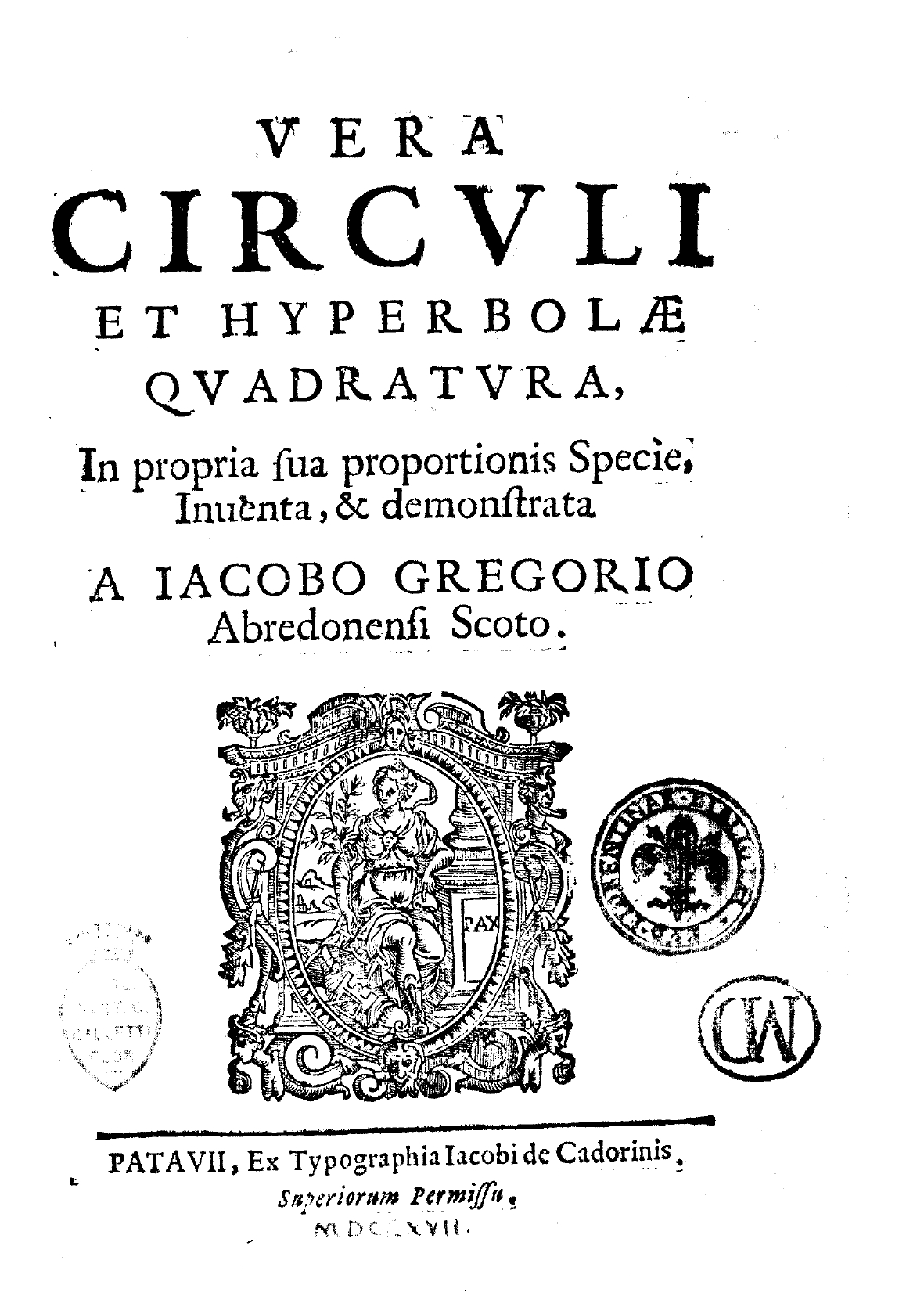
James Gregory, a Scottish mathematician and astronomer born in November 1638 and dying in October 1675, is known for an early practical design for a reflecting telescope—the Gregorian telescope—and for advances in trigonometry, discovering infinite series representations for several trigonometric functions. In his 1668 book *Geometriae Pars Universalis*, he gave the first published statement and proof of the fundamental theorem of calculus, stated from a geometric point of view and only for a special class of curves, for which he was acknowledged by Isaac Barrow. Gregory was born in the manse at Drumoak, Aberdeenshire, the youngest of three children, and was initially educated at home by his mother, Janet Anderson, who endowed him with his appetite for geometry. After his father's death in 1651, his elder brother David took over his education. He attended Aberdeen Grammar School and then Marischal College from 1653 to 1657, graduating AM in 1657. In 1663 he went to London, meeting John Collins and Robert Moray, a founder of the Royal Society. In 1664 he departed for the University of Padua, where he lived with James Caddenhead and was taught by Stefano Angeli. His Padua publications, *Vera circuli et hyperbolæ quadratura* (1667) and *Geometriæ pars universalis* (1668), show the deep influence of Angeli and other Italian mathematicians. Returning to London in 1668, he was elected a Fellow of the Royal Society, then traveled to St Andrews to become the first Regius Professor of Mathematics at the University of St Andrews, a position created for him by Charles II, probably upon the request of Robert Moray. At St Andrews in 1673, he laid the first meridian line across the floor of his lab, 200 years before the Greenwich Meridian, arguably making St Andrews the place where time began. He later became professor at the University of Edinburgh. He married Mary, daughter of George Jameson, painter, and widow of John Burnet; their son James became Professor of Physics at King's College, Aberdeen. About a year after assuming the Chair of Mathematics at Edinburgh, Gregory suffered a stroke while viewing the moons of Jupiter with his students and died a few days later at age 36.
- known_for
- Gregorian telescope, early contributions to the fundamental theorem of calculus,
Lore & Background
James Gregory was born in November 1638 in the manse at Drumoak, Aberdeenshire, the youngest of three children of John Gregory, an Episcopalian Church of Scotland minister, and Janet Anderson. His mother, who initially educated him at home, endowed him with his appetite for geometry; her uncle Alexander Anderson had been a pupil and editor of French mathematician Viète. After his father's death in 1651, his elder brother David took over responsibility for his education. He attended Aberdeen Grammar School and then Marischal College from 1653 to 1657, graduating AM in 1657. In 1663 he went to London, meeting John Collins and Robert Moray, one of the founders of the Royal Society. In 1664 he departed for the University of Padua, passing through Flanders, Paris and Rome on his way. At Padua he lived in the house of James Caddenhead, professor of philosophy, and was taught by Stefano Angeli. Upon his return to London in 1668 he was elected a Fellow of the Royal Society, before travelling to St Andrews in late 1668 to take up his post as the first Regius Professor of Mathematics at the University of St Andrews, a position created for him by Charles II, probably upon the request of Robert Moray. There he laid the first meridian line across the floor of his lab in 1673, 200 years prior to the Greenwich Meridian being established, thus arguably making St Andrews the place where time began. He was successively professor at the University of St Andrews and the University of Edinburgh. He married Mary, daughter of George Jameson, painter, and widow of John Burnet of Elrick, Aberdeen; their son James was Professor of Physics at King's College, Aberdeen. He was the grandfather of John Gregory (FRS 1756); uncle of David Gregorie (FRS 1692) and brother of David Gregory (1627–1720), a physician and inventor. About a year after assuming the Chair of Mathematics at Edinburgh, James Gregory suffered a stroke while viewing the moons of Jupiter with his students. He died a few days later at the age of 36.
Reader's Guide
James Gregory's significance lies in his foundational contributions to mathematics and astronomy. He provided the first published statement and proof of the fundamental theorem of calculus, albeit from a geometric viewpoint and for a special class of curves, a fact acknowledged by Isaac Barrow. Gregory also discovered infinite series representations for several trigonometric functions, including the series for arctan x (often called Gregory's series), and described the method for using the transit of Venus to measure the Earth's distance from the Sun, later adopted by Edmund Halley. His work on the quadrature of the circle and hyperbola, and his geometric demonstrations of series for logarithms and tangents, mark him as a mathematician of acute and penetrating genius. The Gregorian telescope design, though rarely used today, is still employed in radio telescopes such as Arecibo.
Did You Know?
- Gregory's mother Janet Anderson was the daughter of Jean and David Anderson, and her uncle Alexander Anderson had been a pupil and editor of French mathematician Viète.
- In 1673, Gregory laid the first meridian line across the floor of his lab at St Andrews, 200 years before the Greenwich Meridian was established.
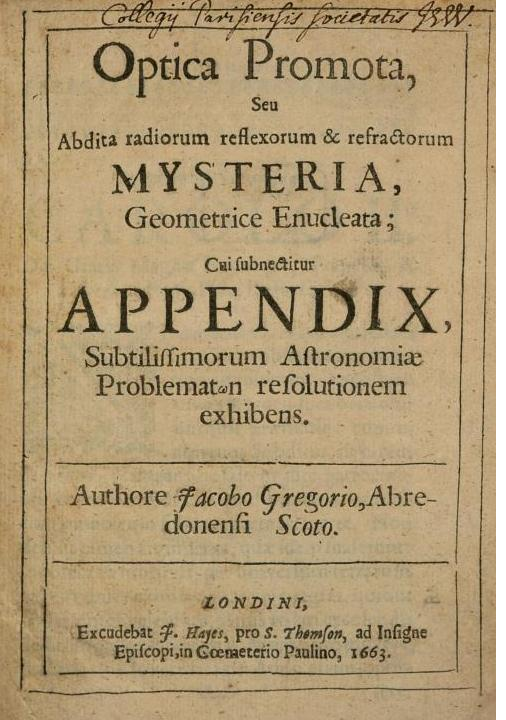
- Gregory described the method for using the transit of Venus to measure the Earth's distance from the Sun in his 1663 book *Optica Promota*.
- He suffered a stroke and died a few days later at age 36 while viewing the moons of Jupiter with his students.
- Gregory's telescope design was eventually built by Robert Hooke 10 years after it was described.
Roots in Aberdeenshire and the Seeds of Geometry
James Gregory entered the world in November 1638 in the manse at Drumoak, Aberdeenshire, the youngest of three children born to John Gregory, an Episcopalian minister in the Church of Scotland, and Janet Anderson. His early intellectual formation was shaped by his mother, who tutored him at home. Janet's own family carried a mathematical lineage: her uncle Alexander Anderson had studied under the French mathematician Viète and even served as his editor. This heritage planted in young James a deep fascination with geometry that would define his life's work. When his father died in 1651, responsibility for his education fell to his elder brother David. Gregory then attended Aberdeen Grammar School before enrolling at Marischal College, where he studied from 1653 to 1657 and earned his Master of Arts degree. These formative years in Scotland laid the groundwork for a mind that would soon reshape the frontiers of mathematics and optics.
The Gregorian Telescope – A Vision Without a Builder
In 1663, Gregory published *Optica Promota*, in which he laid out a design for a reflecting telescope that would bear his name. His key insight was that a parabolic primary mirror could correct spherical aberration as well as the chromatic aberration seen in refracting telescopes. Beyond the primary, he positioned a concave secondary mirror with an elliptical surface past the focal point of the parabolic primary mirror, reflecting the image back through a hole in the primary mirror where it could be conveniently viewed. Gregory also described the method for using the transit of Venus to measure the distance of the Earth from the Sun, a method later advocated by Edmund Halley and adopted as the basis of the first effective measurement of the Astronomical Unit. Yet for all his theoretical brilliance, Gregory confessed he had no practical skill and could find no optician capable of actually constructing one. Robert Hooke, the Oxford physicist, eventually built the telescope 10 years later. Though the configuration is seldom chosen for modern optical telescopes, Gregorian optics remain in active use in radio astronomy, notably in the 'Gregorian dome' of the Arecibo observatory.
Infinite Series and the Birth of Calculus
Gregory's most consequential mathematical contributions emerged during his time in Padua, where the influence of Stefano Angeli and other Italian geometers sharpened his thinking. In *Vera Circuli et Hyperbolae Quadratura* (1667), he demonstrated convergent infinite series that yielded the areas of the circle and the hyperbola to more than twenty decimal places, a feat that also provided a construction for logarithms. Following Huygens's example, he gave constructions of straight lines equal to the arcs of the circle, whose error is still less. The work was reprinted in 1668 with an appendix, *Geometriae Pars*, in which Gregory explained how the volumes of solids of revolution could be determined. Most remarkably, within *Geometriae Pars Universalis* of that same year, Gregory provided what is recognized as the first published statement and proof of the fundamental theorem of calculus, framed in geometric language and limited to a particular class of curves. Isaac Barrow publicly acknowledged his priority. The discovery of the Taylor series can also be attributed to him.
A Brief Career and a Sudden End
Gregory's academic trajectory was swift and distinguished, though tragically short. After a formative sojourn in London in 1663, where he encountered John Collins and Robert Moray, a founding member of the Royal Society, he traveled through Flanders, Paris, and Rome to reach the University of Padua in 1664. There he lodged with James Caddenhead, a Scottish professor of philosophy, and studied under Stefano Angeli. Returning to London in 1668, he was elected a Fellow of the Royal Society and soon accepted a newly created chair at the University of St Andrews—the first Regius Professor of Mathematics, a post established by Charles II, likely at Moray's request. In 1673 he laid a meridian line across his laboratory floor, 200 years prior to the Greenwich Meridian being established, thus arguably making St Andrews the place where time began. He subsequently moved to the University of Edinburgh, where, roughly a year into his tenure, he suffered a stroke while viewing Jupiter's moons with his students. He died within days, in October 1675, at the age of thirty-six.
Gallery
Frequently Asked Questions
What is the Gregorian telescope and who designed it?
The Gregorian telescope is an early practical reflecting-telescope design first described by James Gregory. It stands as one of the first workable mirror-based optical instruments in the history of astronomy.
Why is James Gregory important in the history of mathematics?
Gregory's work bridges several foundational areas at once—practical optics, infinite series for trigonometric functions, and early calculus—making him a connective figure in 17th-century mathematical progress. His contributions, though sometimes overshadowed by later names, helped shape the tools that Newton and Leibniz later built upon.
More in Mathematicians 1-24
Spotted an error? Know more?
This is a living reference — every entry is fact-audited, and reader corrections feed straight into our audit queue. Suggest an edit · See this site's audit record