
Felix Hausdorff
German mathematician, founder of modern topology and set theorist.

via Wikipedia: Felix Hausdorff · see source
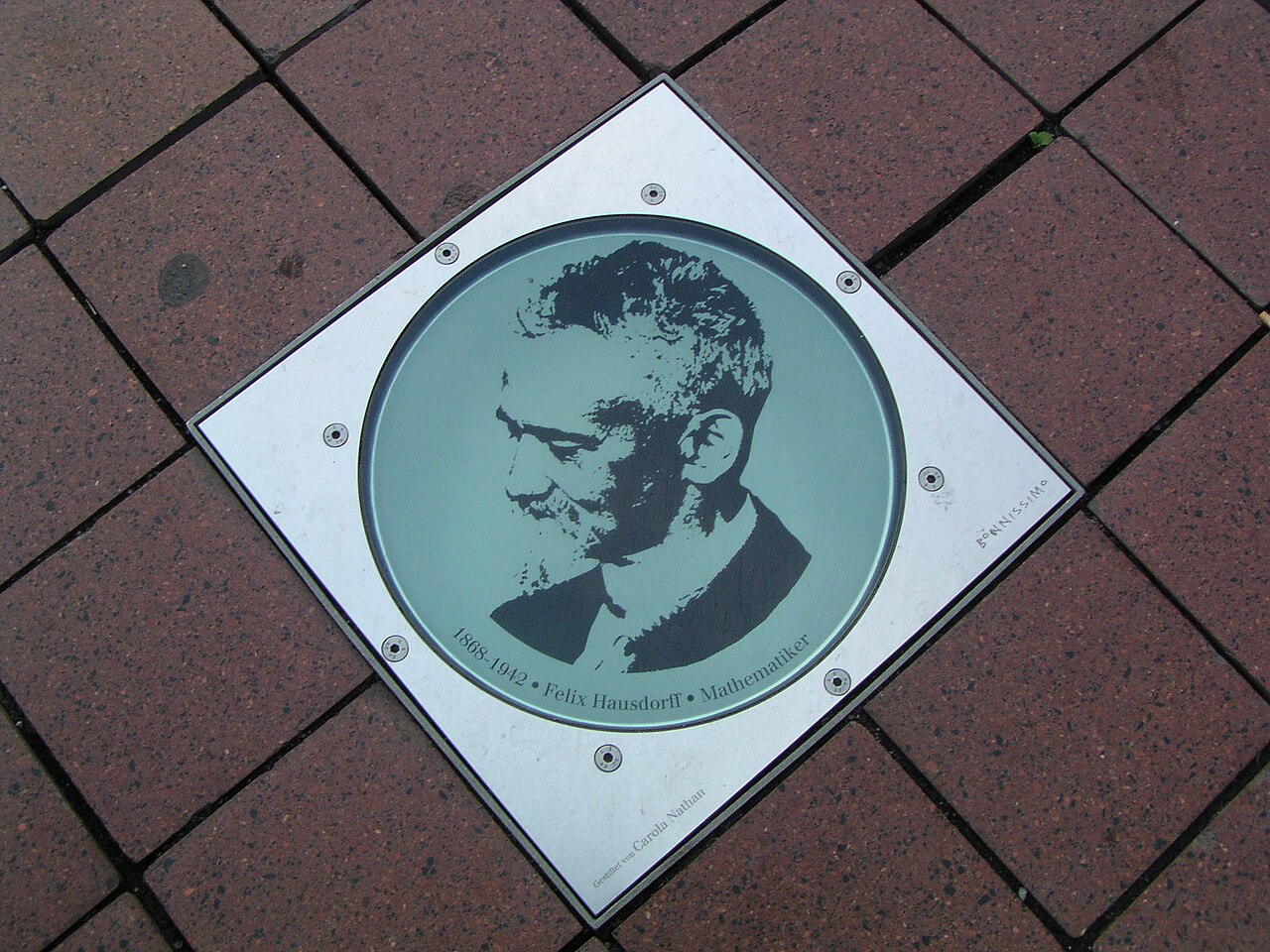
Felix Hausdorff (November 8, 1868 – January 26, 1942) was a German mathematician, pseudonym Paul Mongré, who is considered one of the founders of modern topology and contributed significantly to set theory, descriptive set theory, measure theory, and functional analysis. He was Jewish, and life became difficult for him and his family after Kristallnacht in 1938. The next year he initiated efforts to emigrate to the United States, but was unable to make arrangements to receive a research fellowship. On 26 January 1942, Hausdorff, along with his wife and his sister-in-law, died by suicide by taking an overdose of veronal, rather than comply with German orders to move to a concentration camp in Endenich.
- born
- November 8, 1868
- died
- January 26, 1942
- field
- Mathematics
- nationality
- German
- known_for
- Foundations of modern topology, contributions to set theory, descriptive set the
Verified Timeline
Lore & Background
Hausdorff was born to Jewish parents in Leipzig. His father, Louis Hausdorff, was a merchant who moved the family to Leipzig in autumn 1870; his mother, Hedwig, came from the Jewish Tietz family. From 1878 to 1887 he attended the Old St Nicholas School, Leipzig, a hotbed of humanistic education, where he was an excellent student and class leader. His versatile musical talent was so great that only his father's insistence made him give up his plan to study music and become a composer. He studied mathematics and astronomy from 1887 to 1891, mainly in Leipzig, with one semester in Freiburg (summer 1888) and Berlin (winter 1888/1889). He graduated in 1891 under Heinrich Bruns with a work on astronomical refraction. After his Habilitation in 1895, he became a lecturer at Leipzig. Between 1897 and 1904, 18 of his 22 pseudonymous works were published, including a book of poetry, a play, an epistemological book, and a volume of aphorisms. In 1899 he married Charlotte Goldschmidt; their daughter Lenore (Nora) was born in 1900.
Reader's Guide
Hausdorff's significance lies in his foundational work in topology, particularly through his 1914 book Grundzüge der Mengenlehre, completed in Greifswald and released in April 1914. His contributions to set theory included work on ordered sets and generalizations of the Cantor–Bernstein theorem. In December 1901 he was appointed as adjunct associate professor at Leipzig, but a faculty minority opposed him because he was of the Mosaic faith. He moved to the University of Bonn for the summer semester of 1910, where he began a lecture series on set theory. In 1913 he was appointed full professor at Greifswald, the smallest Prussian university. In 1921 he was appointed to Bonn, where he gave a noteworthy lecture on probability theory in summer 1923, grounding it in measure-theoretic axiomatic theory ten years before Kolmogorov. After Kristallnacht in 1938, life became difficult; he attempted to emigrate to the United States but failed to secure a research fellowship. On January 26, 1942, Hausdorff, his wife, and his sister-in-law died by suicide with veronal rather than comply with orders to move to a concentration camp in Endenich.
Did You Know?
- Hausdorff wrote under the pseudonym Paul Mongré, which comes from the French phrase 'à mon gré' meaning 'according to my taste'.
- He was an excellent student at the Old St Nicholas School, often reciting self-written Latin or German poems at school celebrations.
- His early love of music lasted a lifetime; he held impressive musical evenings at home with the landlord at the piano.
- In 1901, a faculty minority opposed his appointment as adjunct associate professor at Leipzig because he was of the Mosaic faith.
- Hausdorff's lecture on probability theory in summer 1923 grounded the theory in measure-theoretic axiomatic theory, ten years before A. N. Kolmogorov's work.
The Architect of Modern Topology
Felix Hausdorff stands as one of the principal architects of modern topology, and his contributions extended well beyond that single field into set theory, descriptive set theory, measure theory, and functional analysis. His academic path began in Leipzig, where from 1887 to 1891 he pursued mathematics and astronomy, spending brief stints in Freiburg and Berlin. Fellow students remembered him as an extraordinarily curious young man who filled his schedule not only with mathematical and astronomical lectures but also courses in physics, chemistry, geography, philosophy, language, and the social sciences. Under the supervision of astronomer Heinrich Bruns, he completed his doctorate in 1891 with a study of atmospheric light refraction, followed by a habilitation in 1895 on light absorbance. Though mathematically elegant, these early astronomical papers ultimately had limited impact on the broader scientific community. Between his two degrees he fulfilled his military obligation and spent two years performing calculations at the Leipzig observatory. In 1901 he was elevated to adjunct associate professor at Leipzig, a vote that carried a troubling footnote: seven colleagues dissented, and the dean's report noted their objection stemmed from the fact that Hausdorff was of the Mosaic faith.
Poet, Musician, and Philosopher
Beyond his mathematical identity, Hausdorff cultivated a rich inner life as a writer, musician, and thinker. Under the pen name Paul Mongré—drawn from the French phrase à mon gré, meaning "according to my taste"—he published twenty-two literary and philosophical works, eighteen of them between 1897 and 1904. These included a volume of poetry, a stage play, a treatise on epistemology, and a collection of aphorisms. Music was a lifelong passion; as a schoolboy he was so gifted that only his father's firm insistence steered him away from a career as a composer. He remained a devoted admirer of Richard Wagner throughout his life and hosted memorable musical evenings at home, often with his landlord accompanying on the piano. During his Leipzig years he attended music-history lectures delivered by the musicologist Oscar Paul. His social circle in the late 1890s and early 1900s included prominent figures from the literary and artistic worlds—poets, painters, composers, and playwrights such as Richard Dehmel, Max Klinger, Max Reger, and Frank Wedekind—testament to a man who refused to let a single discipline define him.
Family and Roots
Hausdorff was born on November 8, 1868, into a learned Jewish family in what would become a turbulent century. His father, Louis, a merchant who had settled in Leipzig in 1870, was a man of deep scholarship: he had become a Morenu at fourteen and authored several treatises, including a substantial work examining the Aramaic translations of the Bible through the lens of Talmudic law. His mother, Hedwig (also known as Johanna), came from the prominent Tietz family, a branch of which included Hermann Tietz, the founder of a major department-store chain whose name was later forcibly Aryanised to Hertie under the Nazis. Felix attended the Old St Nicholas School in Leipzig, a gymnasium renowned for its humanistic tradition, where he served as class leader for many years and delighted audiences by reciting poems he had composed himself in Latin and German. In 1899 he married Charlotte Goldschmidt, daughter of a Jewish physician; her stepmother was the noted suffragist and early-childhood educator Henriette Goldschmidt. Their only child, a daughter named Lenore (Nora), was born in 1900 and would survive the Nazi era, living until 1991 in Bonn.
Defiance in the Final Hours
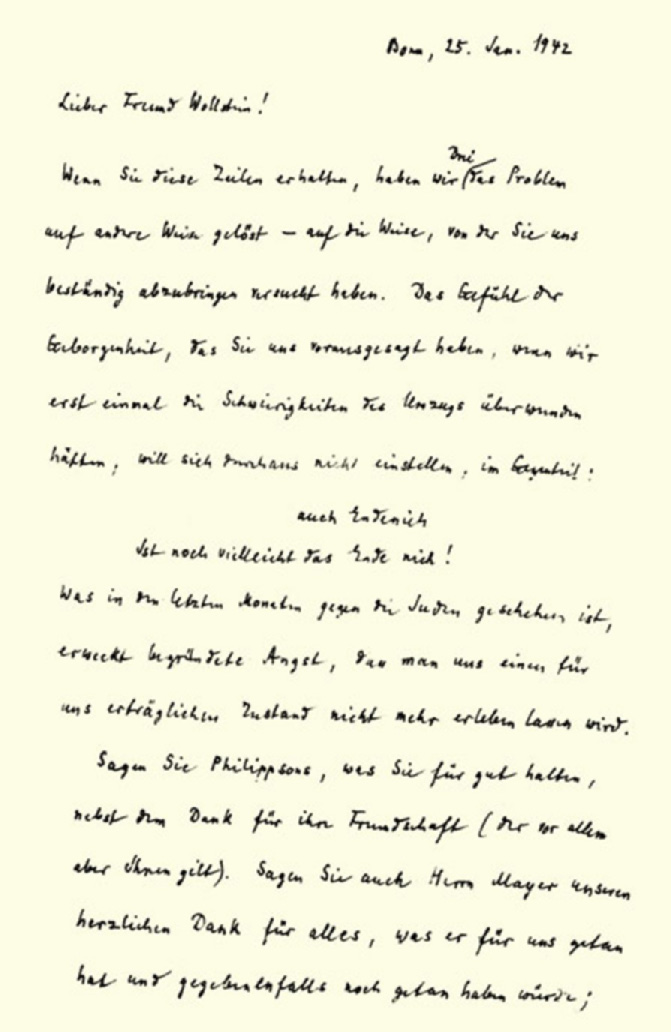
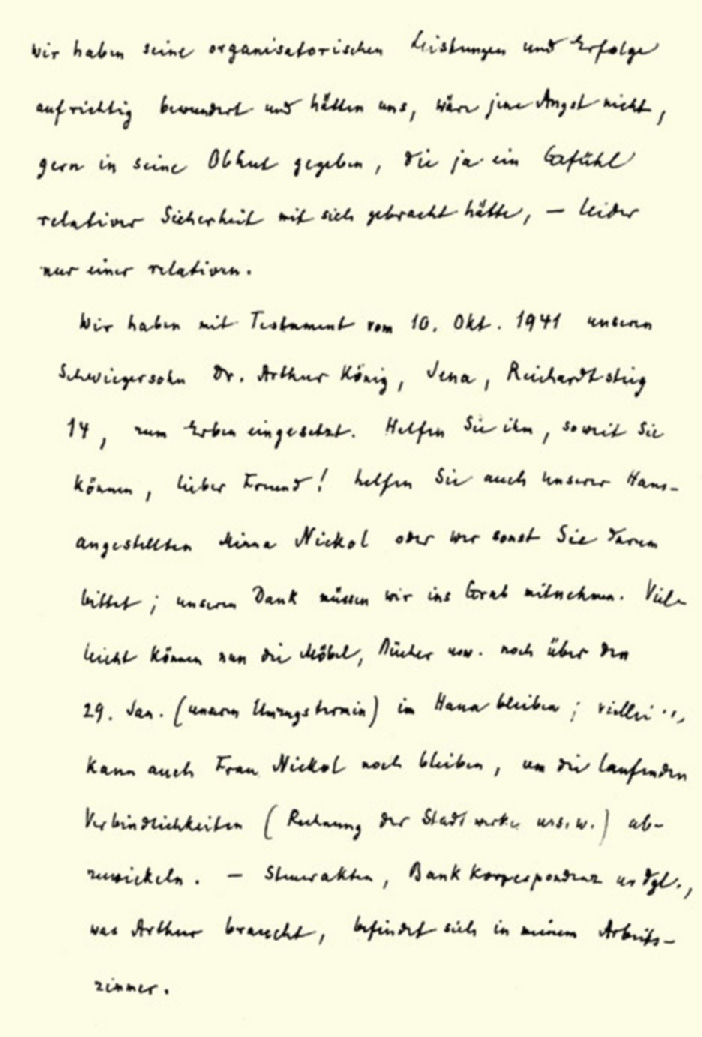
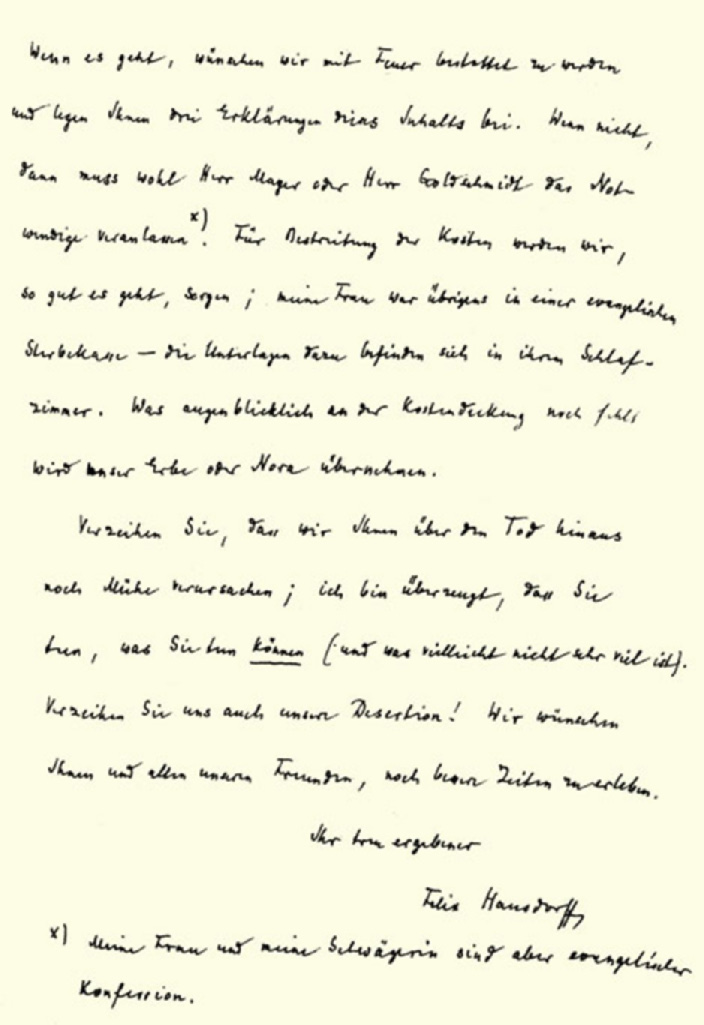
The last years of Hausdorff's life were marked by escalating persecution. As a Jew in Germany, he and his family faced mounting danger after the Kristallnacht pogrom of November 1938. The following year he began arranging emigration to the United States, but the effort stalled when he could not secure a research fellowship to support the move. By early 1942 the situation had become unbearable: German authorities issued orders requiring Jewish residents to relocate to the Endenich concentration camp. On January 26, 1942, Felix Hausdorff, his wife Charlotte, and his sister-in-law chose death over compliance. Together they took an overdose of the barbiturate veronal. Their act was not one of despair alone but of deliberate refusal—a final assertion of personal dignity and autonomy in the face of a regime determined to strip them of both. Their daughter Lenore, born in 1900, survived the Nazi era and lived until 1991 in Bonn, a quiet testament to the family's endurance even as the parents made their ultimate stand. Magda Dierkesmann, a longtime guest in the Hausdorff home between 1926 and 1932, remained one of the few witnesses to the warmth and intellectual richness of that household before the darkness closed in.
Gallery

Frequently Asked Questions
Who is Felix Hausdorff?
A German mathematician (1868–1942) widely regarded as one of the principal architects of modern topology, with lasting contributions across set theory, measure theory, and functional analysis.
What is the Hausdorff distance?
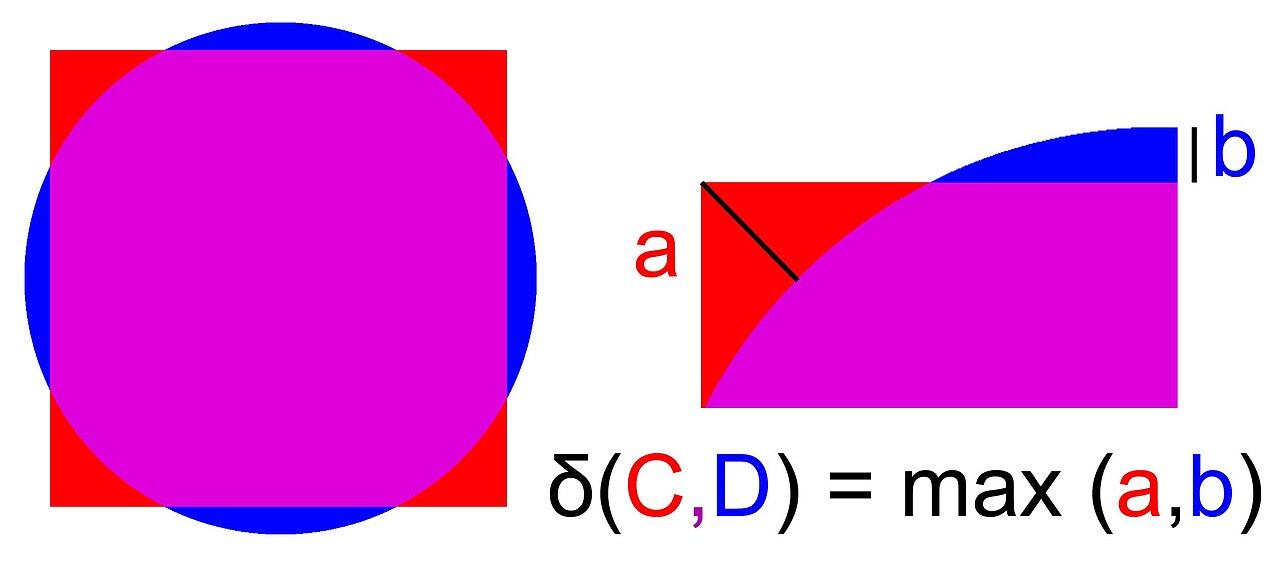
It is a metric that quantifies how far apart two subsets of a metric space are from one another, essentially capturing the largest gap between the two sets. It remains one of the most frequently applied tools in topology and analysis.
How did Felix Hausdorff's life end?
He took his own life on January 26, 1942, in Bonn, after the Nazi government had dismissed him from his university post and he could no longer continue his academic work.
What is the Paul Mongré pseudonym?
Under this name, Hausdorff published collections of short literary and philosophical essays, revealing a creative and reflective side that existed alongside his mathematical career.
Why is Felix Hausdorff important to modern mathematics?
His axiomatic treatment of topological spaces helped turn topology into a rigorous, independent discipline, and his ideas in set theory and functional analysis continue to underpin much of modern pure mathematics.
More in Mathematicians 1-24
Elsewhere in the Mathematicians universe
Spotted an error? Know more?
This is a living reference — every entry is fact-audited, and reader corrections feed straight into our audit queue. Suggest an edit · See this site's audit record