
Henri Poincaré
French polymath and last universalist mathematician.

via Wikipedia: Henri Poincaré · see source
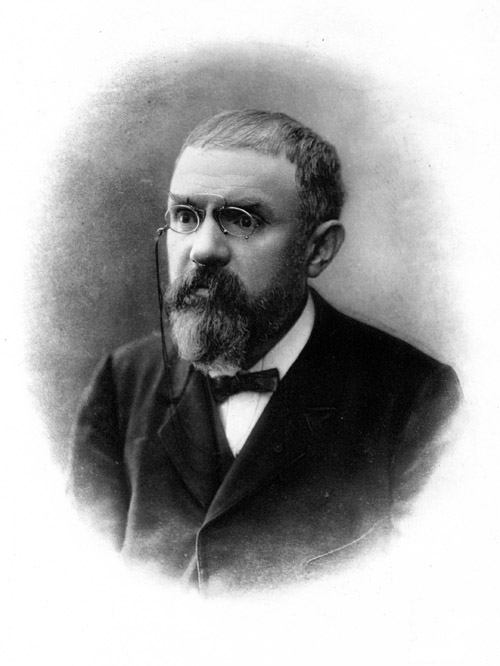
Jules Henri Poincaré (29 April 1854 – 17 July 1912) was a French mathematician, theoretical physicist, engineer, and philosopher of science. Often described as a polymath, he has been called 'The Last Universalist' in mathematics and 'the Gauss of modern mathematics.' He made original fundamental contributions to pure and applied mathematics, mathematical physics, and celestial mechanics. He is regarded as the creator of algebraic topology and the first to discover a chaotic deterministic system, laying the foundations of modern chaos theory. He also formulated the Poincaré conjecture, solved in 2002–2003 by Grigori Perelman, and presented the Lorentz transformations in their modern symmetrical form, an important step in special relativity.
- born
- 29 April 1854, Cité Ducale, Nancy, France
- died
- 17 July 1912
- field
- Mathematics, theoretical physics, engineering, philosophy of science
- nationality
- French
- known_for
- Chaos theory, algebraic topology, Poincaré conjecture, Poincaré recurrence theor
Verified Timeline
Lore & Background
Poincaré was born on 29 April 1854 in the Cité Ducale neighborhood of Nancy, into an influential French family. His father Léon Poincaré was a professor of medicine at the University of Nancy. His cousin Raymond Poincaré served as President of France from 1913 to 1920. After a childhood bout with diphtheria, he entered the Lycée in Nancy in 1862, where he spent eleven years and proved to be one of the top students in every topic. His mathematics teacher described him as a 'monster of mathematics,' and he won first prizes in the concours général. He graduated in 1871 with a baccalauréat in both letters and sciences, having served alongside his father in the Ambulance Corps during the Franco-Prussian War of 1870. He entered the École Polytechnique as the top qualifier in 1873, studied mathematics under Charles Hermite, and published his first paper in 1874. After graduating in 1875, he studied at the École des Mines from November 1875 to June 1878, receiving the degree of ordinary mining engineer in March 1879. That same year, he earned his doctorate in mathematics from the University of Paris, with a thesis on differential equations. He began teaching as a junior lecturer at the University of Caen in December 1879, married Louise Poulain d'Andecy on 20 April 1881, and soon moved to the University of Paris, where he held chairs in Physical and Experimental Mechanics, Mathematical Physics and Theory of Probability, and Celestial Mechanics and Astronomy. He also worked as a mining engineer, becoming chief engineer of the Corps des Mines in 1893 and inspector general in 1910. In 1881–1882, Poincaré created a new branch of mathematics: the qualitative theory of differential equations. He became the first person to discover a chaotic deterministic system through his research on the three-body problem, which laid the foundations of modern chaos theory. He introduced the Poincaré recurrence theorem and formulated the Poincaré conjecture, which became one of the famous unsolved problems in mathematics until it was solved in 2002–2003 by Grigori Perelman. He presented the Lorentz transformations in their modern symmetrical form, discovered the remaining relativistic velocity transformations in 1905, and first proposed gravitational waves (ondes gravifiques) propagating at the speed of light as required by the Lorentz transformations. In 1912, he wrote an influential paper providing a mathematical argument for quantum mechanics.
Reader's Guide
Henri Poincaré was considered the dominant figure in mathematics and theoretical physics during his time, described by mathematician Paul Painlevé as 'the living brain of the rational sciences.' His work spanned pure and applied mathematics, mathematical physics, and celestial mechanics. He is credited with creating the field of algebraic topology and introducing automorphic forms. He also made important contributions to algebraic geometry, number theory, complex analysis, and Lie theory. In physics, he played a crucial role in the formulation of special relativity, providing the modern symmetrical form of the Lorentz transformations and ensuring the perfect invariance of all of Maxwell's equations. He also proposed gravitational waves in 1905 and contributed to early quantum theory with a 1912 paper. As a philosopher of science, he originated the conventionalist view and was regarded by Karl Popper as the greatest philosopher of science of all time. His legacy includes the Poincaré group, named after him, and his influence on Henri Becquerel, whom he inspired to discover radioactivity through his interest in X-rays. The Poincaré conjecture, one of the most famous unsolved problems in mathematics, was solved in 2002–2003 by Grigori Perelman. Poincaré served as president of the French Academy of Sciences in 1906, president of the Société astronomique de France from 1901 to 1903, and twice president of the Société mathématique de France (1886, 1900).
Did You Know?
- Poincaré's mathematics teacher described him as a 'monster of mathematics.'
- He served alongside his father in the Ambulance Corps during the Franco-Prussian War of 1870.
- He was on the scene of a mining disaster at Magny in August 1879 in which 18 miners died, and he carried out the official investigation.
- He won Oscar II, King of Sweden's mathematical competition in 1887 for a resolution of the three-body problem.
- Philosopher Karl Popper regarded Poincaré as the greatest philosopher of science of all time.
The Last Universalist: A Mathematician Without Borders
Often called 'The Last Universalist' and compared to Gauss himself, Henri Poincaré (1854–1912) stood as the most respected mathematician of his era, excelling across every branch of the discipline as it then existed. He is widely regarded as the founder of algebraic topology and is credited with introducing automorphic forms, while also making significant contributions to algebraic geometry, number theory, complex analysis, and Lie theory. His work on the three-body problem produced something unprecedented: the first identification of a chaotic deterministic system, a discovery that became the bedrock of modern chaos theory. He also formulated the Poincaré recurrence theorem, asserting that a system will eventually return arbitrarily close to its starting state given enough time, a result with sweeping implications. In the early 1900s he posed the Poincaré conjecture, a problem that would remain unsolved for over a century until Grigori Perelman resolved it in 2002–2003. Poincaré also played a key role in bringing non-Euclidean geometry into mainstream mathematical practice, reshaping how geometers thought about space.
Laying the Groundwork for Relativity and Modern Physics
Beyond pure mathematics, Poincaré made foundational contributions to theoretical physics that prefigured the revolution of the twentieth century. He recognized the deep importance of invariance—how physical laws must remain unchanged under different transformations—and was the first to write the Lorentz transformations in their modern symmetrical form. In a 1905 letter to Hendrik Lorentz he identified the remaining relativistic velocity transformations, achieving perfect invariance of all of Maxwell's equations, a critical step toward the formulation of special relativity. He published further foundational papers that same year and, remarkably, proposed the existence of gravitational waves—ondes gravifiques—emanating from a body and traveling at the speed of light, a consequence he derived from the Lorentz transformations. In 1912 he wrote an influential mathematical argument supporting quantum mechanics. His curiosity about X-rays also planted the seeds that led Henri Becquerel to discover radioactivity. The Poincaré group, a central object in both physics and mathematics, bears his name in recognition of his introduction of the group notion.
From Nancy's Lycée to the Mines of Vesoul
Born in the Cité Ducale neighborhood of Nancy on 29 April 1854, Henri Poincaré grew up in an influential family. His father Léon was a professor of medicine at the University of Nancy, and his cousin Raymond would later serve as President of France. A bout of diphtheria in childhood meant his mother Eugénie Launois had to teach him at home. In 1862 he entered the Lycée in Nancy, where he spent eleven years as an outstanding student. His mathematics teacher called him a 'monster of mathematics,' and he won first prizes in the national concours général. His weakest subjects were music and physical education, where he was described as average—difficulties likely linked to poor eyesight and absentmindedness. During the Franco-Prussian War of 1870 he served in the Ambulance Corps alongside his father. He entered the École Polytechnique in 1873 as the top qualifier, studied under Charles Hermite, and published his first paper in 1874. After graduating in 1875 he spent three years at the École des Mines, earning a mining-engineering degree in 1879. As a young inspector for the Vesoul region, he investigated a mine collapse at Magny in August 1879 in which eighteen miners died.
Public Intellect, Philosophy of Science, and Lasting Influence
Poincaré was widely regarded as the dominant figure in both mathematics and theoretical physics during his lifetime. The mathematician Paul Painlevé called him 'the living brain of the rational sciences,' a testament to the breadth and depth of his influence. His impact extended well beyond the technical: philosopher Karl Popper considered him the greatest philosopher of science of all time, and Poincaré is credited with originating the conventionalist view in the philosophy of science. He has been called 'the philosopher par excellence of modern science.' As a public intellectual, Poincaré held several prestigious leadership roles: president of the French Academy of Sciences in 1906, president of the Société astronomique de France from 1901 to 1903, and twice president of the Société mathématique de France, in 1886 and 1900. On the political front, he was a firm believer in equality for all, yet he maintained a wary distance from the anti-intellectual positions he associated with the Catholic Church of his era. His death on 17 July 1912 marked the loss of a mind whose reach spanned pure mathematics, physics, engineering, and philosophy in a way that has rarely been matched.
Gallery
Frequently Asked Questions
Who is Henri Poincaré?
Henri Poincaré (1854–1912) was a French polymath who worked across mathematics, theoretical physics, engineering, and the philosophy of science. He is widely regarded as the founder of algebraic topology and a pivotal figure in the birth of chaos theory.
What is the Poincaré Conjecture and was it ever solved?
It is a topological statement asserting that any compact, simply connected three-dimensional manifold is homeomorphic to the ordinary three-sphere. The problem resisted proof for nearly a century until Grigori Perelman published a complete solution in 2003, confirming Poincaré's original intuition from 1904.
How did Poincaré contribute to physics before Einstein?
Poincaré independently derived the Lorentz transformations and articulated a relativistic framework in 1905, laying much of the mathematical groundwork for special relativity. His work also touched on the foundations of quantum theory and the principle of relativity, though he stopped short of redefining the nature of time and space the way Einstein did.
Why do fans call Poincaré 'The Last Universalist'?
The nickname reflects the fact that he published substantive, original results in pure mathematics, celestial mechanics, mathematical physics, and philosophy of science all within the same decade. No later mathematician has matched that breadth of first-rate contributions across so many distinct disciplines simultaneously.
What was unusual about Poincaré's eyesight and how did it shape his work?
Poincaré was nearly blind from early childhood and could not read a page of formulas in one sitting. He compensated by thinking almost entirely in vivid mental images of geometric shapes and spatial relationships, a habit that critics later credited as the engine behind his topological and dynamical-systems breakthroughs.
More in Mathematicians 25-36
Elsewhere in the Mathematicians universe
Spotted an error? Know more?
This is a living reference — every entry is fact-audited, and reader corrections feed straight into our audit queue. Suggest an edit · See this site's audit record