
Hermann Minkowski
Mathematician who united space and time into four-dimensional spacetime.

via Wikipedia: Hermann Minkowski · see source
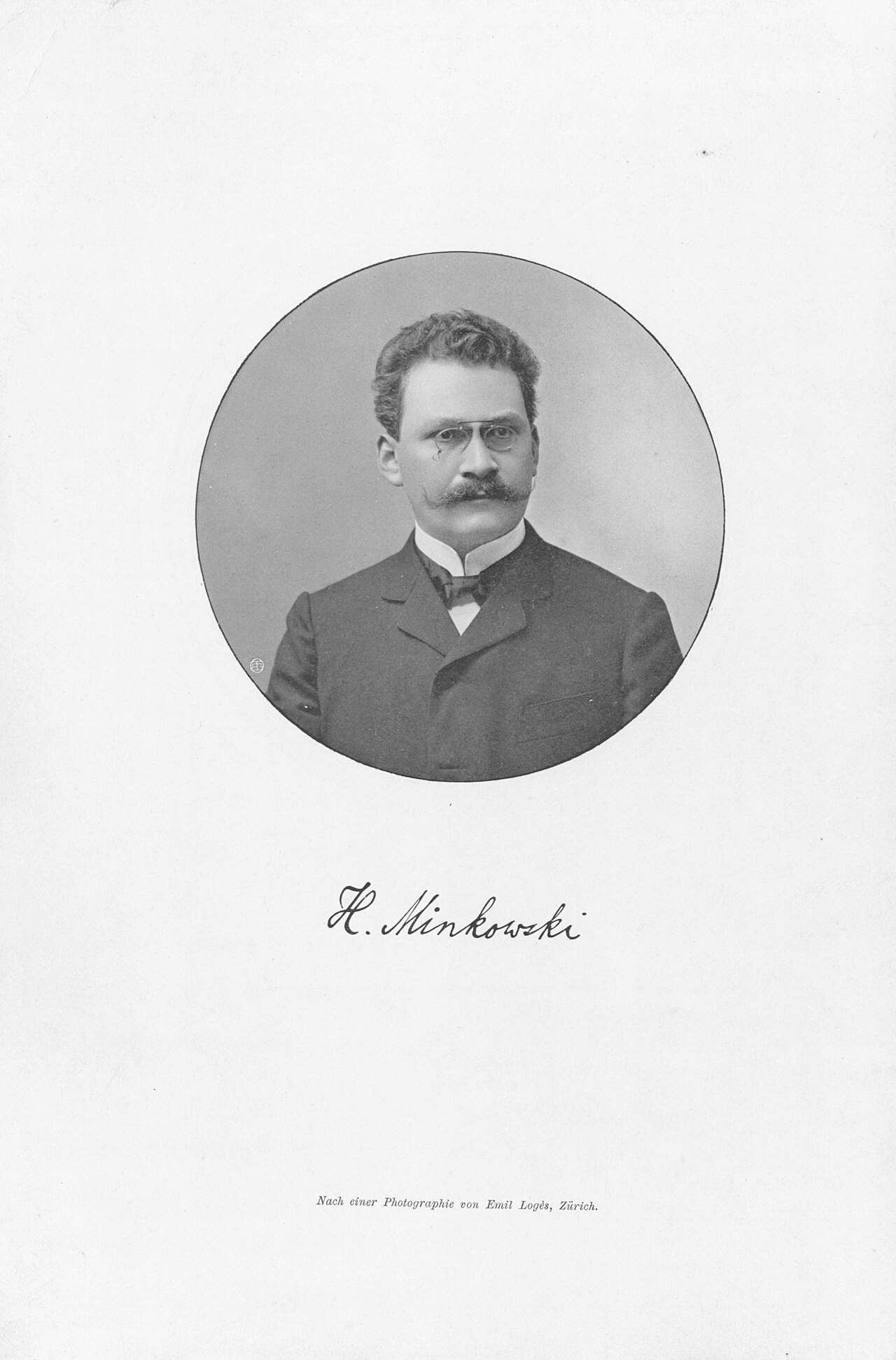
Hermann Minkowski (22 June 1864 – 12 January 1909) was a mathematician and professor at the University of Königsberg, ETH Zürich, and the University of Göttingen, described variously as German, Polish, Lithuanian-German, or Russian. He created and developed the geometry of numbers and elements of convex geometry, and used geometrical methods to solve problems in number theory, mathematical physics, and the theory of relativity. Minkowski is perhaps best known for his foundational work describing space and time as a four-dimensional space, now known as "Minkowski spacetime", which facilitated geometric interpretations of Albert Einstein's special theory of relativity (1905).
- born
- 22 June 1864, Aleksotas, Suwałki Governorate, Kingdom of Poland (then part of Ru
- died
- 12 January 1909, Göttingen, Germany
- field
- Mathematics, mathematical physics
- nationality
- Variously described as German, Polish, Lithuanian-German, or Russian
- known_for
- Minkowski spacetime, geometry of numbers, convex geometry, Minkowski sausage
Verified Timeline
Lore & Background
Hermann Minkowski was born in the town of Aleksotas, the Suwałki Governorate, the Kingdom of Poland, since 1864 part of the Russian Empire, to Lewin Boruch Minkowski, a merchant who subsidized the building of the choral synagogue in Kovno, and Rachel Taubmann, both Jewish. To escape Jewish persecution in the Russian Empire, the family moved to Königsberg in 1872, where the father became involved in rag export and later in manufacture of mechanical clockwork tin toys (he operated his firm Lewin Minkowski & Son with his eldest son Max). Minkowski studied in Königsberg and taught in Bonn (1887–1894), Königsberg (1894–1896) and Zürich (1896–1902), and finally in Göttingen from 1902 until his death in 1909. He married Auguste Adler in 1897 with whom he had two daughters; the electrical engineer and inventor Reinhold Rudenberg was his son-in-law. Minkowski died of appendicitis in Göttingen on 12 January 1909. Max Born delivered the obituary on behalf of the mathematics students at Göttingen. David Hilbert's obituary of Minkowski illustrates the deep friendship between the two mathematicians: "Since my student years, Minkowski was my best, most dependable friend who supported me with all the depth and loyalty that was so characteristic of him."
Reader's Guide
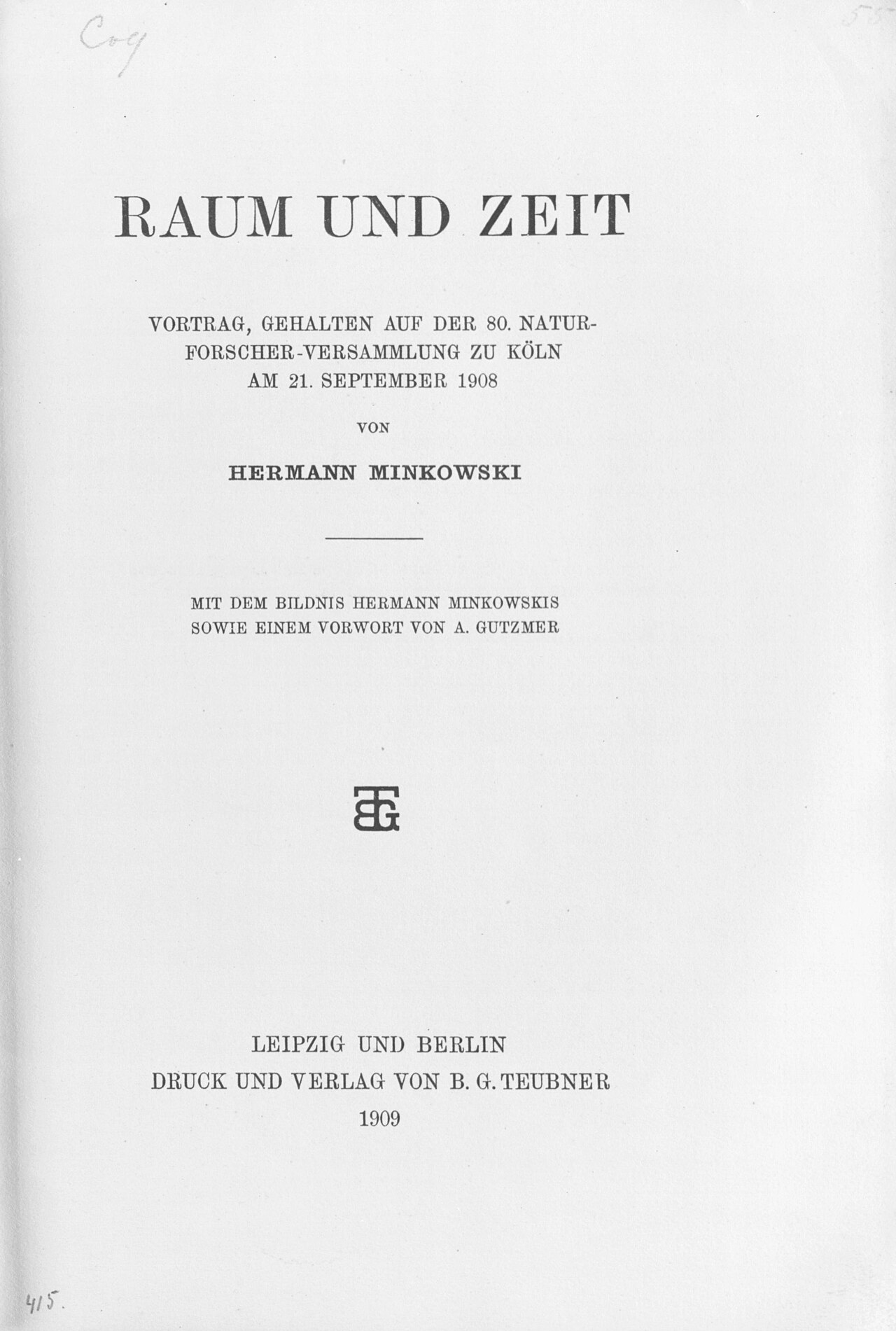
Hermann Minkowski's most famous contribution is his foundational work describing space and time as a four-dimensional space, now known as "Minkowski spacetime", which facilitated geometric interpretations of Albert Einstein's special theory of relativity (1905). By 1908 Minkowski realized that the special theory of relativity could best be understood in a four-dimensional space, in which time and space are not separated entities but intermingled, and in which the Lorentz geometry of special relativity can be effectively represented using the invariant interval x² + y² + z² − c²t². The beginning part of his address called "Space and Time" delivered at the 80th Assembly of German Natural Scientists and Physicians (21 September 1908) is now famous: "Henceforth space by itself, and time by itself, are doomed to fade away into mere shadows, and only a kind of union of the two will preserve an independent reality." He also created and developed the geometry of numbers and elements of convex geometry, and used geometrical methods to solve problems in number theory. He is also the creator of the Minkowski Sausage and the Minkowski cover of a curve. The main-belt asteroid 12493 Minkowski and M-matrices are named in Minkowski's honor.
Did You Know?
- In 1883, while still a student at Königsberg at age 18, Minkowski was awarded the Mathematics Prize of the French Academy of Sciences for his manuscript on the theory of quadratic forms, sharing it with the eminent English mathematician Henry Smith, who was awarded posthumously.
- Minkowski was one of Albert Einstein's teachers at the Eidgenössisches Polytechnikum, today the ETH Zurich.
- Minkowski died of appendicitis in Göttingen on 12 January 1909, and Max Born delivered the obituary on behalf of the mathematics students.
- The main-belt asteroid 12493 Minkowski and M-matrices are named in Minkowski's honor.
- Minkowski's father Lewin Boruch Minkowski subsidized the building of the choral synagogue in Kovno.
Academic Ascent and the Geometry of Numbers
Hermann Minkowski was born in 1864 in Aleksotas, a town in the Suwałki Governorate of the Kingdom of Poland, then part of the Russian Empire. His father, Lewin Boruch, was a Jewish merchant who had helped fund a choral synagogue in Kovno. In 1872 the family relocated to Königsberg to escape anti-Jewish pressures, where the father turned to rag export and later to manufacturing mechanical clockwork tin toys. Minkowski studied at the Albertina University of Königsberg, earning his doctorate in 1885 under Ferdinand von Lindemann. His early brilliance was striking: at just eighteen, still a student, he shared the French Academy of Sciences' Mathematics Prize for a manuscript on quadratic forms—an honor that provoked considerable unrest among English mathematicians because he was paired with the far more celebrated Henry Smith, who received it posthumously. The committee refused to reverse its decision. His work on the arithmetic of quadratic forms in multiple variables led him toward geometric thinking in higher-dimensional spaces, culminating in his 1896 presentation of the geometry of numbers, a method that recast number-theoretic problems in geometric terms. He also devised the Minkowski Sausage and the Minkowski cover of a curve, tools that remain part of the mathematical vocabulary.
The Four-Dimensional Revolution
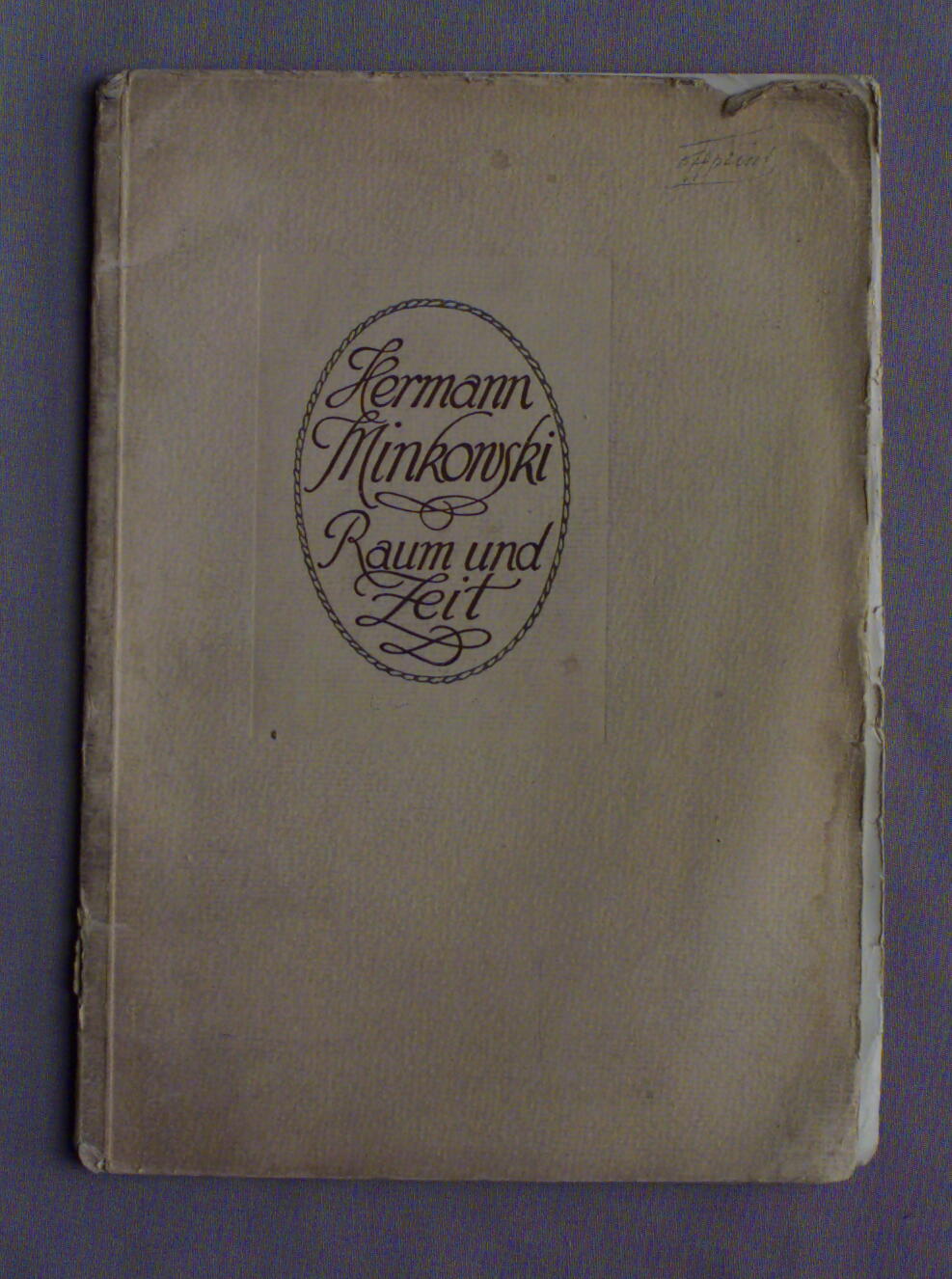
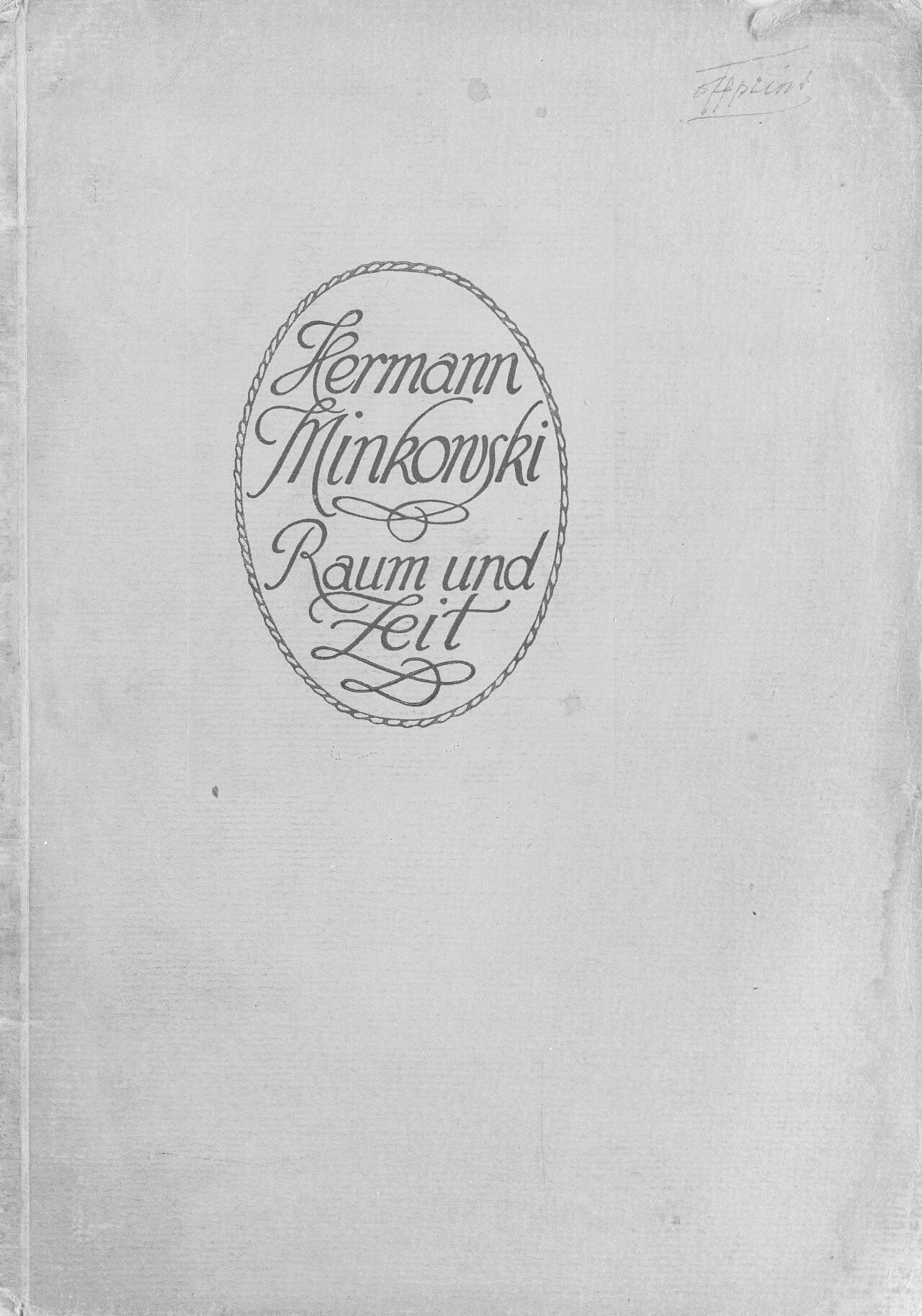
By 1908, Minkowski had come to see that Albert Einstein's 1905 special theory of relativity, building on earlier contributions by Lorentz and Poincaré, demanded a fundamentally new geometric framework. Rather than treating space and time as separate arenas, he proposed that they were interwoven into a single four-dimensional continuum, now universally called Minkowski spacetime. In this structure, the Lorentz geometry of special relativity could be expressed through the invariant interval, a quantity combining spatial coordinates and time in a way that remained unchanged across reference frames. The mathematical underpinnings of this construction could be traced back to the hyperboloid model of hyperbolic space, already known in the nineteenth century, where isometries in hyperbolic geometry corresponded to Lorentz transformations. Contributors such as Wilhelm Killing, Henri Poincaré, Homersham Cox, and Alexander Macfarlane had all touched on related ideas in the preceding decades. Minkowski delivered his landmark address, "Space and Time," at the 80th Assembly of German Natural Scientists and Physicians on 21 September 1908, declaring that space and time as separate entities were doomed to fade away into mere shadows, and that only their union would endure.
A Life Shaped by Displacement
Minkowski's personal story was marked by the upheavals of Jewish life in the Russian Empire. Born in Aleksotas to Lewin Boruch Minkowski and Rachel Taubmann, he grew up in a family that faced the realities of religious persecution. The 1872 relocation to Königsberg was a practical response to those pressures, and the family's economic life there—first in rag export, then in the manufacture of mechanical clockwork tin toys under the firm Lewin Minkowski & Son, operated with his eldest brother Max—reflected the modest entrepreneurial spirit of a displaced community. Minkowski's nationality is variously listed in sources as German, Polish, Lithuanian-German, or Russian, a testament to the fluid borders and identities of the era. He had a younger brother, Oskar, who became a well-known physician and medical researcher. In 1897, Minkowski married Auguste Adler; the couple had two daughters, and his son-in-law would be the electrical engineer and inventor Reinhold Rudenberg. His life ended abruptly on 12 January 1909 in Göttingen, where he died of appendicitis at the age of forty-four.
Friendship, Students, and Enduring Legacy
Minkowski's relationships with fellow mathematicians were as significant as his theorems. His bond with David Hilbert, formed during their student years in Königsberg, endured for decades and was described by Hilbert in an obituary as a friendship built on a shared love of science, likening their joint explorations to wandering through a garden full of flowers, discovering hidden pathways, and marveling together at new perspectives. Hilbert called Minkowski a rare gift from heaven. At Göttingen, where Minkowski joined the mathematics department in 1902, he became a close colleague of Hilbert and a teacher to students such as Constantin Carathéodory. At ETH Zürich, he had been one of Albert Einstein's instructors, a connection that made his later reinterpretation of Einstein's relativity all the more resonant. Max Born delivered the obituary on behalf of Göttingen's mathematics students. Beyond the academy, Minkowski's name endures in the main-belt asteroid 12493 Minkowski and in the mathematical objects known as M-matrices, both named in his honor.
Gallery


Frequently Asked Questions
Who is Hermann Minkowski?
Minkowski was a mathematician born in 1864 in what is now Lithuania, who held professorships in Königsberg, Zürich, and Göttingen. His cultural identity is variously claimed by Lithuanian, Polish, German, and Russian traditions.
What is Minkowski spacetime and why does it matter?
It is the four-dimensional framework that treats space and time as a single unified continuum rather than separate entities. This geometric reformulation of special relativity later became essential groundwork for Einstein's general theory of gravitation.
What other areas of mathematics did Minkowski contribute to?
Beyond his relativity work, he is credited with founding the geometry of numbers and making major advances in convex geometry. He also applied geometric reasoning to problems in number theory and mathematical physics.
Where did Minkowski live and work during his career?
He held positions at the University of Königsberg, ETH Zürich, and the University of Göttingen. He died in Göttingen in January 1909 at the age of forty-four.
Why is Minkowski considered important in the history of mathematics and physics?
His vision of unifying space and time into a single geometric object reshaped how physicists describe the structure of the universe. His work in the geometry of numbers also opened an entire branch of mathematics that remains actively studied today.
More in Mathematicians 25-36
Elsewhere in the Mathematicians universe
Spotted an error? Know more?
This is a living reference — every entry is fact-audited, and reader corrections feed straight into our audit queue. Suggest an edit · See this site's audit record