
James Joseph Sylvester
English mathematician who shaped matrix theory and American mathematics.

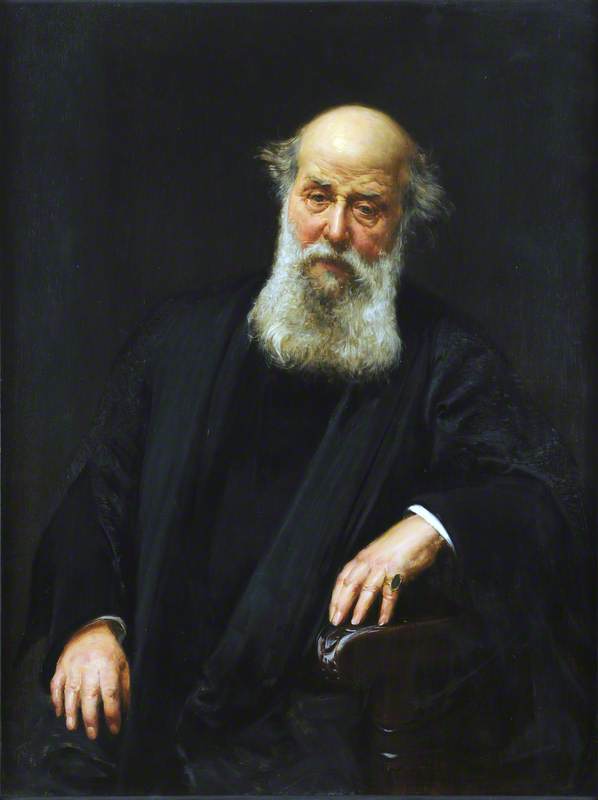
Alfred Edward Emslie · Public domain
James Joseph Sylvester (3 September 1814 – 15 March 1897) was an English mathematician. He made fundamental contributions to matrix theory, invariant theory, number theory, partition theory, and combinatorics. He played a leadership role in American mathematics in the later half of the 19th century as a professor at the Johns Hopkins University and as founder of the American Journal of Mathematics. At his death, he was a professor at Oxford University.
- born
- 3 September 1814, London, England
- died
- 15 March 1897, London, England
- field
- Mathematics
- nationality
- English
- known_for
- Matrix theory, invariant theory, number theory, partition theory, combinatorics;
Verified Timeline
Lore & Background
James Joseph Sylvester was born in London on 3 September 1814, the son of Abraham Joseph, a Jewish merchant. He later adopted the surname Sylvester when his older brother did so upon emigration to the US. At age 14, he studied under Augustus De Morgan at the University of London, but his family withdrew him after he was accused of stabbing a fellow student with a knife. He then attended the Liverpool Royal Institution. He began studying mathematics at St John's College, Cambridge in 1831, where his tutor was John Hymers. Despite a prolonged illness interrupting his studies for almost two years, he ranked second in the Cambridge tripos in 1837. However, he was not issued a degree because graduates were required to accept the Thirty-nine Articles of the Church of England, which as a Jew he could not do. For the same reason, he could not compete for a Fellowship or obtain a Smith's prize. In 1838, he became professor of natural philosophy at University College London and in 1839 a Fellow of the Royal Society of London. In 1841, he was awarded a BA and an MA by Trinity College Dublin. In 1841, Sylvester moved to the US to become professor of mathematics at the University of Virginia, the first Jewish professor at any American college or university. He left after only four months following a classroom incident in which a student he had criticized hit him with a bludgeon and he struck back with a sword-cane; the student collapsed in shock and Sylvester believed (wrongly) that he had killed him. He resigned when he felt the university authorities had not sufficiently disciplined the student. He moved to New York City and befriended mathematician Benjamin Peirce and physicist Joseph Henry, but left in November 1843 after being denied appointment at Columbia College, again for his Judaism. Returning to England, he was hired in 1844 by the Equity and Law Life Assurance Society, where he developed actuarial models and served as de facto CEO. He studied for the Bar, meeting fellow mathematician Arthur Cayley, with whom he made significant contributions to invariant theory and matrix theory. He did not obtain a university mathematics position until 1855, when he became professor at the Royal Military Academy, Woolwich, retiring in 1869 due to the compulsory retirement age of 55. The academy initially refused his full pension, relenting only after a prolonged public controversy during which Sylvester took his case to the letters page of The Times. In 1876, Sylvester returned to the US as the inaugural professor of mathematics at the new Johns Hopkins University in Baltimore, Maryland. His salary was $5,000, which he demanded be paid in gold, but after negotiation it was not. He founded the American Journal of Mathematics in 1878. That same year, with his help, Christine Ladd-Franklin was accepted into Johns Hopkins University; her application was signed 'C. Ladd', and the university offered the position without realizing she was a woman. When they did, the board tried to revoke the offer, but Sylvester insisted she be his student. She held a fellowship for three years, but the trustees did not allow her name in circulars with other fellows, and dissension over her presence forced one trustee to resign. In 1883, Sylvester returned to England to become Savilian Professor of Geometry at Oxford University, holding the chair until his death, although in 1892 the university appointed a deputy professor to the same chair. He was on the governing body of Abingdon School.
Reader's Guide
James Joseph Sylvester's significance lies in his foundational contributions to several branches of mathematics, particularly matrix theory and invariant theory, where he coined the term 'matrix' in 1850. He also introduced the terms 'graph' (in the sense of network), 'discriminant', and 'totient' for Euler's totient function. His work with Arthur Cayley on invariant theory and matrix theory was a long collaboration. In discrete geometry, he is remembered for Sylvester's problem and a result on the orchard problem, and in matrix theory for Sylvester's determinant identity, which generalizes the Desnanot–Jacobi identity. His collected scientific work fills four volumes. Sylvester also played a key role in American mathematics, founding the American Journal of Mathematics and being the first Jewish professor at an American college. His legacy includes the Sylvester Medal, instituted by the Royal Society of London in 1901, and Sylvester House at Johns Hopkins University. He never married and had no known children; his lifelong passion for poetry led him to publish The Laws of Verse. He died at 5 Hertford Street, London on 15 March 1897 and is buried in Balls Pond Road Cemetery on Kingsbury Road in London.
Did You Know?
- Sylvester was not issued a Cambridge degree after ranking second in the tripos in 1837 because, as a Jew, he could not accept the Thirty-nine Articles of the Church of England.
- In 1841, he became the first Jewish professor at any American college or university when he taught mathematics at the University of Virginia.
- He left the University of Virginia after only four months when a student he had criticized hit him with a bludgeon and Sylvester struck back with a sword-cane, believing (wrongly) he had killed the student.
- Sylvester founded the American Journal of Mathematics in 1878; the only other US math journal at the time was The Analyst.
- He helped Christine Ladd-Franklin become a student at Johns Hopkins in 1878 after the university initially offered her a fellowship without realizing she was a woman.
A Career Spanning Two Continents
Sylvester's academic path wove between England and America across six decades. He entered St John's College, Cambridge in 1831, and despite a prolonged illness that interrupted his studies for nearly two years, he still placed second in the tripos examination in 1837. His first transatlantic move came in 1841, when he took a mathematics post at the University of Virginia, making him the first Jewish professor at an American college. That appointment ended after just four months following a violent classroom confrontation. Back in England, he built actuarial models for a life assurance company before securing a mathematics chair at the Royal Military Academy, Woolwich, where he taught from 1855 until compulsory retirement at fifty-five in 1869. In 1876 he crossed the Atlantic once more, becoming the inaugural mathematics professor at the newly established Johns Hopkins University in Baltimore. He founded the American Journal of Mathematics there in 1878. His final academic posting was the Savilian Professorship of Geometry at Oxford, which he held from 1883 until his death in 1897.
Battling Prejudice in Academia
Sylvester's Jewish faith was a recurring obstacle that shaped the arc of his professional life. At Cambridge, his refusal to affirm the Thirty-nine Articles of the Church of England meant he was denied a degree despite his strong tripos result, and he was barred from competing for a Fellowship or the Smith's prize. In America, his 1843 rejection from a Columbia College mathematics post was attributed directly to his religion, prompting his return to England. It was not until 1872, more than three decades after his initial studies, that Cambridge finally conferred upon him the B.A. and M.A. degrees he had been owed. Even at Johns Hopkins, institutional resistance to admitting Christine Ladd-Franklin as a fellow exposed the era's narrow thinking, a barrier Sylvester actively fought. His dispute over a full pension at Woolwich, which he escalated through the letters page of The Times, demonstrated a man who refused to absorb institutional injustice in silence.
Shaping Mathematical Language and Community
Sylvester left an indelible imprint on both mathematical vocabulary and the infrastructure of the discipline. In 1850 he coined the word "matrix," a term now indispensable across science and engineering. He also introduced the word "graph" in its network-theoretic sense, the term "discriminant," and the word "totient" to describe Euler's totient function. His long collaboration with Arthur Cayley yielded major advances in invariant theory and matrix theory. Beyond nomenclature, Sylvester founded the American Journal of Mathematics in 1878, creating a crucial publication venue at a time when the only other American mathematical journal was The Analyst. His collected scientific work fills four volumes. In discrete geometry, Sylvester's problem and his orchard-problem result remain standard references, while his determinant identity generalizes the Desnanot–Jacobi identity. In 1880 the Royal Society recognized his lifetime contributions with the Copley Medal, its highest scientific honor.
Friendships and a Life Without Conventional Ties
Sylvester never married and left no children; biographical sources record no romantic relationships. His personal life was instead anchored by deep intellectual friendships. In New York he grew close to the Harvard mathematician Benjamin Peirce and the Princeton physicist Joseph Henry. In England, his most enduring partnership was with Arthur Cayley, whom he met while both were studying law for the Bar. Their long collaboration produced landmark work in invariant and matrix theory. Sylvester also championed the careers of others. He recognized the promise of Christine Ladd-Franklin's earlier work in the Educational Times, and when Johns Hopkins attempted to revoke her fellowship upon discovering her gender, he insisted she remain his student. She held the fellowship for three years, though trustees refused to print her name alongside other fellows' in circulars, and her continued presence ultimately forced one original trustee to resign. Sylvester also served on the governing body of Abingdon School.
Gallery




Frequently Asked Questions
Who is James Joseph Sylvester?
Sylvester was a 19th-century English mathematician (1814–1897) whose work spanned matrix theory, invariant theory, number theory, partition theory, and combinatorics. He is widely regarded as one of the founding figures of modern algebra.
What mathematical terms did Sylvester coin?
He is credited with introducing the words 'matrix,' 'graph,' 'discriminant,' and 'totient' into mathematical vocabulary. These terms remain standard in their respective fields to this day.
What was Sylvester's role in American mathematics?
He held a professorship at Johns Hopkins University in the latter half of the 1800s and founded the American Journal of Mathematics, helping to establish the United States as a serious center for mathematical research.
What is Sylvester's determinant identity?
It is a fundamental result in matrix theory that relates the determinant of a product of two matrices to the determinants of the individual factors, forming a cornerstone of linear algebra.
Where did Sylvester spend the end of his career?
He died in London on 15 March 1897 while serving as a professor at Oxford University, closing out a career that had bridged British and American academic life.
More in Mathematicians 25-36
Elsewhere in the Mathematicians universe
Spotted an error? Know more?
This is a living reference — every entry is fact-audited, and reader corrections feed straight into our audit queue. Suggest an edit · See this site's audit record