
Hermann Weyl
German mathematician who bridged pure mathematics and theoretical physics.

via Wikipedia: Hermann Weyl · see source
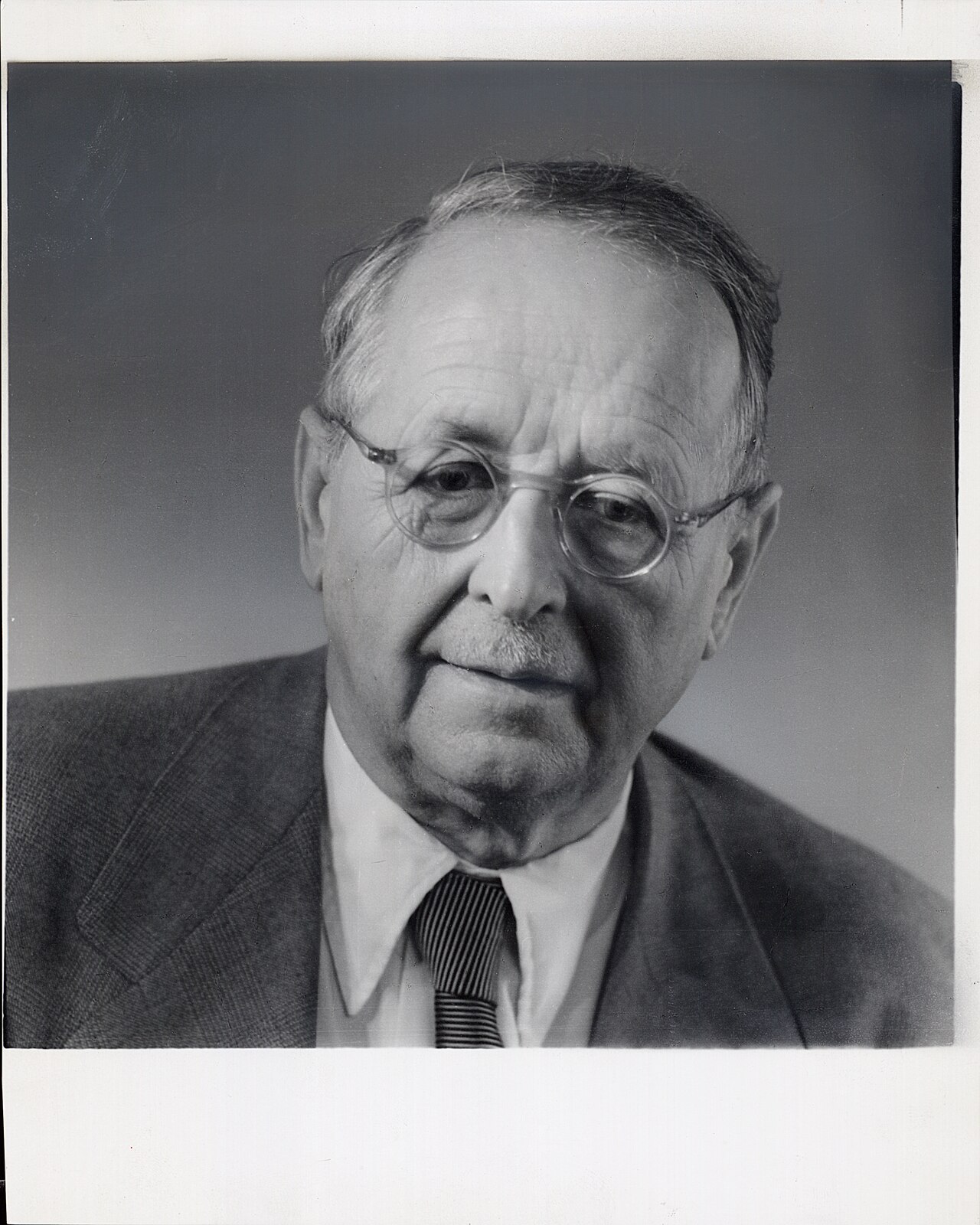
Hermann Klaus Hugo Weyl (9 November 1885 – 8 December 1955) was a German mathematician, theoretical physicist, logician and philosopher. Although much of his working life was spent in Zürich, Switzerland, and then Princeton, New Jersey, he is associated with the University of Göttingen tradition of mathematics, represented by Carl Friedrich Gauss, David Hilbert and Hermann Minkowski. His research has had major significance for theoretical physics as well as purely mathematical disciplines such as number theory. He was one of the most influential mathematicians of the twentieth century, and an important member of the Institute for Advanced Study during its early years.
- born
- 9 November 1885, Elmshorn, Germany
- died
- 8 December 1955, Zürich, Switzerland
- field
- Mathematics, theoretical physics, logic, philosophy
- nationality
- German
- known_for
- Weyl law, gauge theory, compact group theory, Weyl quantization, contributions t
Verified Timeline
Lore & Background
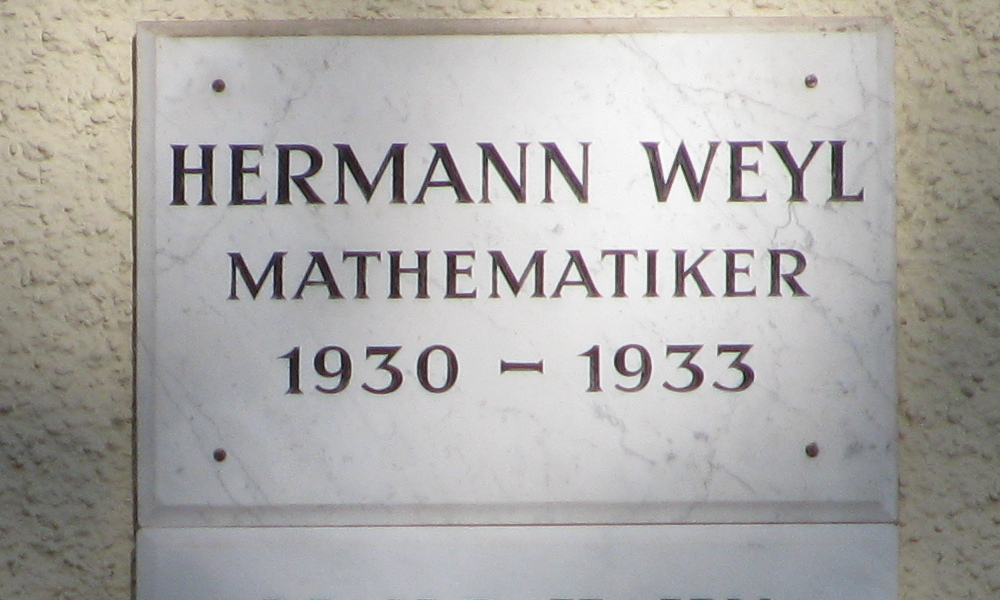
Hermann Weyl was born in Elmshorn, a small town near Hamburg, and attended the Gymnasium Christianeum in Altona. From 1904 to 1908, he studied mathematics and physics at both the University of Göttingen and the Ludwig-Maximilians-Universität München. His doctorate was awarded at the University of Göttingen under the supervision of David Hilbert, whom he greatly admired. In September 1913, in Göttingen, Weyl married Friederike Bertha Helene Joseph, a philosopher and translator of Spanish literature, through whom he became familiar with Husserl's thought. They had two sons, Fritz Joachim Weyl (19 February 1915 – 20 July 1977) and Michael Weyl (15 September 1917 – 19 March 2011), both born in Zürich. Helene died in Princeton, New Jersey, on 5 September 1948. In 1950, Hermann married sculptor Ellen Bär, widow of professor Richard Josef Bär of Zürich. After taking a teaching post for a few years, Weyl left Göttingen in 1913 for Zurich to take the chair of mathematics at ETH Zurich, where he was a colleague of Albert Einstein, who was working out the details of the theory of general relativity. Einstein had a lasting influence on Weyl, who became fascinated by mathematical physics. In 1921, Weyl met Erwin Schrödinger, a theoretical physicist at the University of Zurich; they became close friends. Weyl left the University of Zurich in 1930 to become Hilbert's successor at the University of Göttingen, leaving when the Nazis assumed power in 1933, particularly as his wife was Jewish. He had been offered one of the first faculty positions at the new Institute for Advanced Study in Princeton, but declined because he did not desire to leave his homeland. As the political situation in Germany grew worse, he changed his mind and accepted when offered the position again. He remained there until his retirement in 1951. Together with his second wife Ellen, he spent his time in Princeton and Zürich, and died from a heart attack on 8 December 1955, while living in Zürich. Weyl was a pantheist.
Reader's Guide
Hermann Weyl's significance lies in his exceptionally wide-ranging contributions. In 1911 he published 'Über die asymptotische Verteilung der Eigenwerte', proving that the eigenvalues of the Laplacian in a compact domain are distributed according to the Weyl law. In 1913, he published 'Die Idee der Riemannschen Fläche', giving a unified treatment of Riemann surfaces using point set topology. In 1918, in 'Raum, Zeit, Materie', he introduced the notion of gauge and gave the first example of what is now known as a gauge theory, an attempt to model the electromagnetic field and the gravitational field as geometrical properties of spacetime. From 1923 to 1938, Weyl developed the theory of compact groups in terms of matrix representations, proving a fundamental character formula for compact Lie groups. These results are foundational in understanding the symmetry structure of quantum mechanics, which he put on a group-theoretic basis, including spinors. His 1927 Weyl quantization provided a bridge between classical and quantum physics. Weyl also showed how to use exponential sums in diophantine approximation with his criterion for uniform distribution mod 1, a fundamental step in analytic number theory. In 'The Continuum', he developed the logic of predicative analysis using lower levels of Bertrand Russell's ramified theory of types. Freeman Dyson wrote that Weyl alone bore comparison with the 'last great universal mathematicians of the nineteenth century', Henri Poincaré and David Hilbert. Michael Atiyah commented that whenever he examined a mathematical topic, he found that Weyl had preceded him.
Did You Know?
- Weyl's wife Helene was a philosopher and disciple of Edmund Husserl, and it was through her that Hermann became familiar with Husserl's thought.
- Weyl had a childless love affair with Annemarie Schrödinger, the wife of his close friend Erwin Schrödinger.
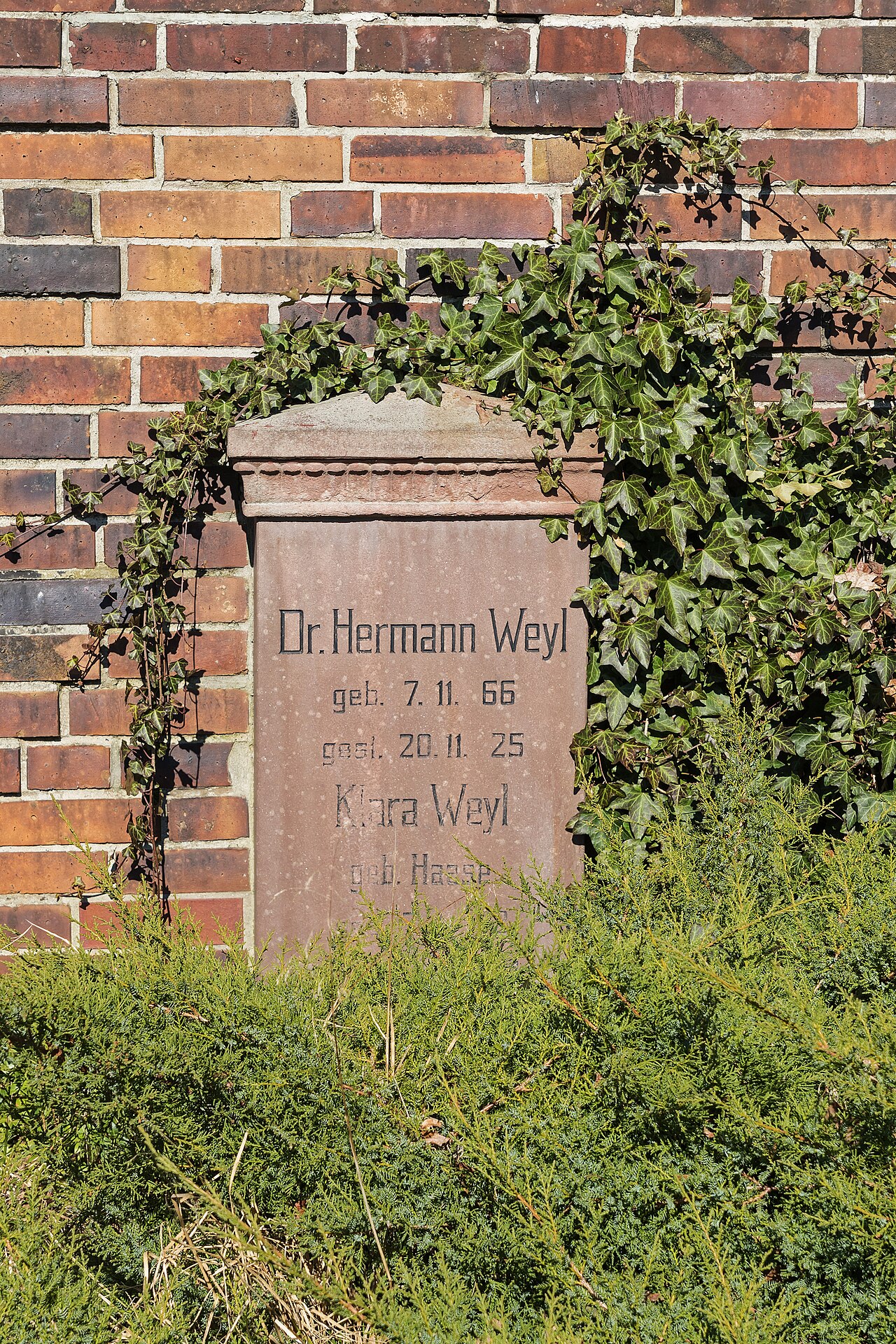
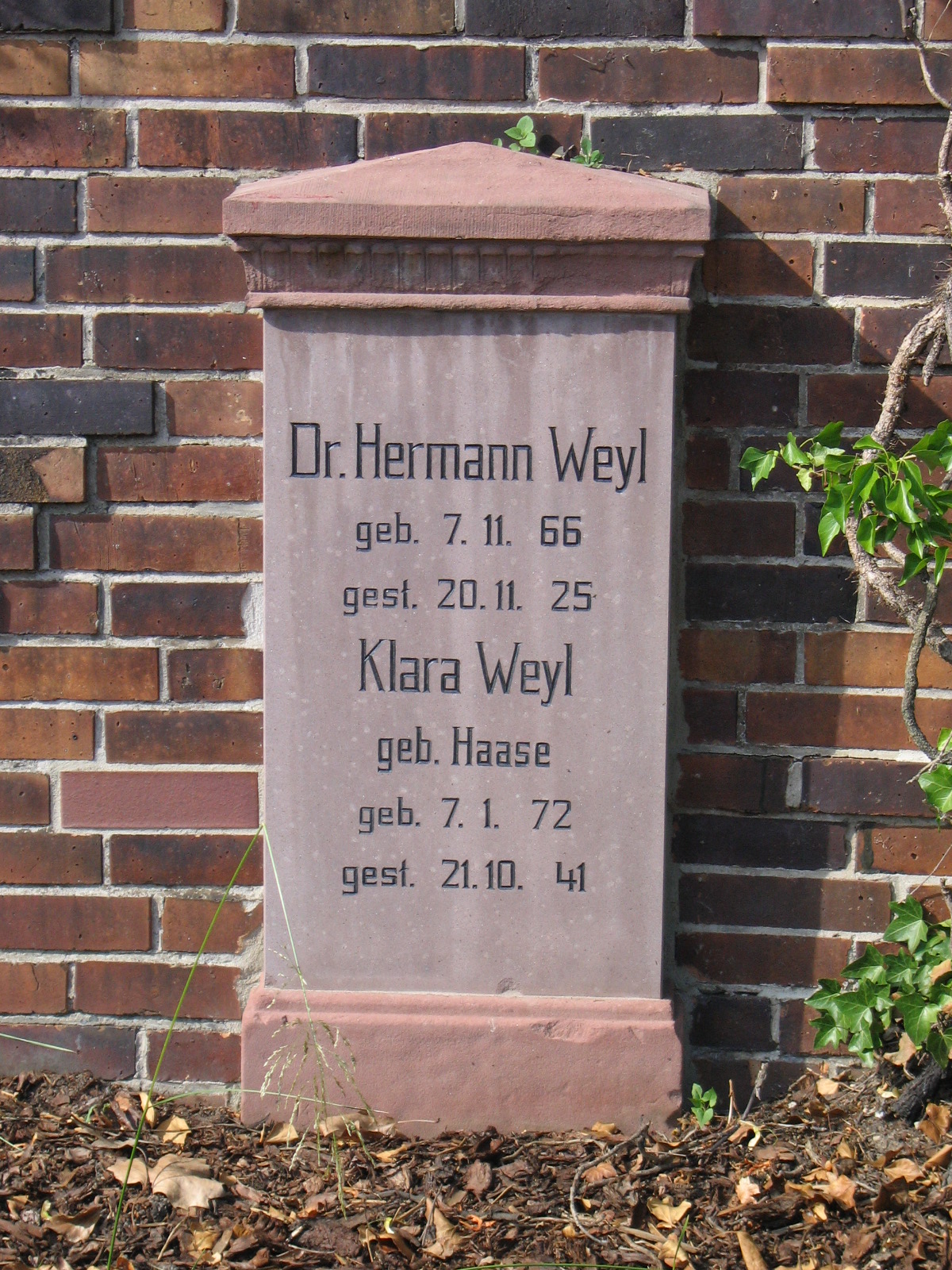
- Weyl was cremated in Zurich on 12 December 1955, and his ashes were interred in an outdoor columbarium vault in the Princeton Cemetery in 1999.
- Weyl was a Plenary Speaker of the International Congress of Mathematicians in 1928 at Bologna and an Invited Speaker in 1936 at Oslo.
- Weyl briefly shifted his position wholly to the intuitionism of L. E. J. Brouwer after publishing 'The Continuum'.
The Göttingen Thread and a Life in Motion
Hermann Weyl's intellectual identity was forged in the shadow of one of mathematics' most storied institutions. Born in 1885 in the small town of Elmshorn near Hamburg, he trained at both Göttingen and Munich between 1904 and 1908, ultimately earning his doctorate under David Hilbert, a figure he deeply admired. Though his career took him far from Germany—first to ETH Zurich in 1913, where he worked alongside Albert Einstein as the latter refined general relativity, and later to Princeton's Institute for Advanced Study—he remained, in spirit, a child of the Göttingen tradition that stretched back through Gauss and Minkowski. In 1930 he returned to Göttingen to succeed Hilbert himself, but the Nazi rise to power in 1933, compounded by his wife's Jewish heritage, forced him to flee. He had initially turned down a Princeton post, unwilling to abandon his homeland, yet circumstances compelled him to accept when the offer came again. He remained at the Institute for Advanced Study until his 1951 retirement, splitting his later years between Princeton and Zürich, where a heart attack took him in December 1955.
A Mathematician Who Redrew the Boundaries
Weyl's output defied easy categorization. In 1911 he proved what is now called the Weyl law, establishing how the eigenvalues of the Laplacian distribute themselves across a compact domain, and in 1912 he offered a fresh variational proof of the same result. He kept returning to the question, extending it to elasticity systems and ultimately formulating the Weyl conjecture, thereby launching an entire subfield of modern analysis. The following year, his treatise Die Idee der Riemannschen Fläche delivered the first truly unified account of Riemann surfaces, grounding the theory in point-set topology and drawing on L. E. J. Brouwer's pioneering topological work. Beyond pure mathematics, Weyl was among the earliest thinkers to envision a single framework that would weld general relativity to the equations governing electromagnetism. His published interests spanned space, time, matter, logic, symmetry, philosophy, and even the history of mathematics, while his work in number theory left lasting marks. The sheer breadth of his contributions made him, by any measure, one of the twentieth century's most consequential mathematical minds.
Helene, Husserl, and the Personal Current
Weyl's private life was shaped as much by intellectual kinship as by romance. In 1913, in Göttingen, he wed Helene Joseph, a philosopher trained in the phenomenological school of Edmund Husserl and a translator of Spanish literature, particularly the writings of José Ortega y Gasset. It was through Helene's deep engagement with Husserl's thought that Hermann first encountered and was profoundly influenced by phenomenology. The couple had two sons, Fritz Joachim and Michael, both born in Zürich. Helene's death in Princeton in 1948 prompted a memorial service attended by prominent mathematicians Oswald Veblen and Richard Courant. Five years later, Weyl married the sculptor Ellen Bär, widow of a Zürich professor. His personal relationships extended beyond marriage: he formed a close friendship with Erwin Schrödinger, whom he met in 1921 at the University of Zurich, and the two maintained a bond that lasted decades. Weyl also described himself as a pantheist, a worldview that colored his philosophical writings and his approach to the unity of natural law.
Measured Against the Giants
The measure of Weyl's standing among his peers is captured in two remarks that have become almost proverbial. Freeman Dyson observed that Weyl alone warranted comparison with Henri Poincaré and David Hilbert, the last great universal mathematicians of the nineteenth century—a comparison few twentieth-century figures could claim. Michael Atiyah, reflecting on his own research, noted that whenever he turned to a new mathematical topic, he discovered Weyl had already traversed that territory. Institutional recognition followed in steady waves: he delivered a Plenary Address at the 1928 International Congress of Mathematicians in Bologna and was invited to speak again at the 1936 Oslo congress. Fellowships and memberships piled up through the 1920s and 1930s, spanning the American Physical Society, the American Academy of Arts and Sciences, the American Philosophical Society, and the National Academy of Sciences. He was a founding figure at the Institute for Advanced Study during its formative years. In 1999, four decades after his death, his ashes were finally laid to rest in a columbarium vault at Princeton Cemetery, placed beside those of his son Michael.
Gallery
Frequently Asked Questions
Who is Hermann Weyl?
Hermann Weyl (1885–1955) was a German-born mathematician, theoretical physicist, logician, and philosopher whose work spanned number theory, compact group theory, and the foundations of quantum mechanics. He is closely tied to the Göttingen school of mathematics even though he spent most of his professional life in Zürich and Princeton.
What are Hermann Weyl's most famous contributions?
He is best known for the Weyl law in spectral theory, his foundational work on gauge theory and compact groups, and the Weyl quantization procedure linking classical and quantum mechanics. His research also made significant contributions to general relativity and number theory.
Where did Hermann Weyl work during his career?
Although he is associated with the University of Göttingen tradition, Weyl spent the bulk of his working life in Zürich, Switzerland, and later at Princeton in New Jersey. He was born in Elmshorn, Germany, in 1885 and died in Zürich in 1955.
How did Hermann Weyl bridge pure mathematics and theoretical physics?
Weyl applied deep tools from pure mathematics—such as compact group theory and spectral analysis—to problems in quantum mechanics and general relativity, making him equally at home in both disciplines. His gauge theory work, in particular, laid important groundwork for modern particle physics.
Why is Hermann Weyl considered one of the most influential mathematicians of the twentieth century?
His research touched nearly every major area of mathematics and physics, from number theory to quantum mechanics, and his ideas continue to shape both fields. He is regarded as a direct heir to the Göttingen lineage of Gauss, Hilbert, and Minkowski.
More in Mathematicians 25-36
Related in Mathematicians
Links follow this subject's own source article.
Elsewhere in the Mathematicians universe
Spotted an error? Know more?
This is a living reference — every entry is fact-audited, and reader corrections feed straight into our audit queue. Suggest an edit · See this site's audit record