
Henry Briggs (mathematician)
English mathematician who introduced common logarithms.

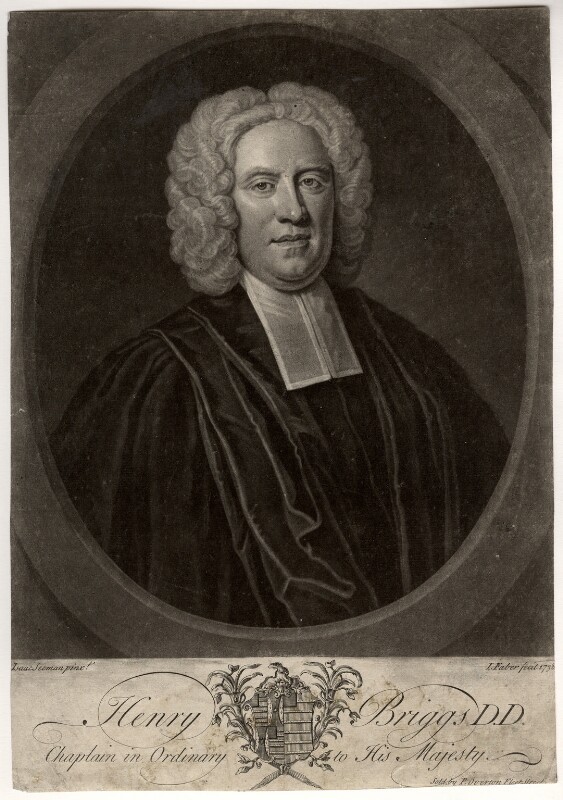
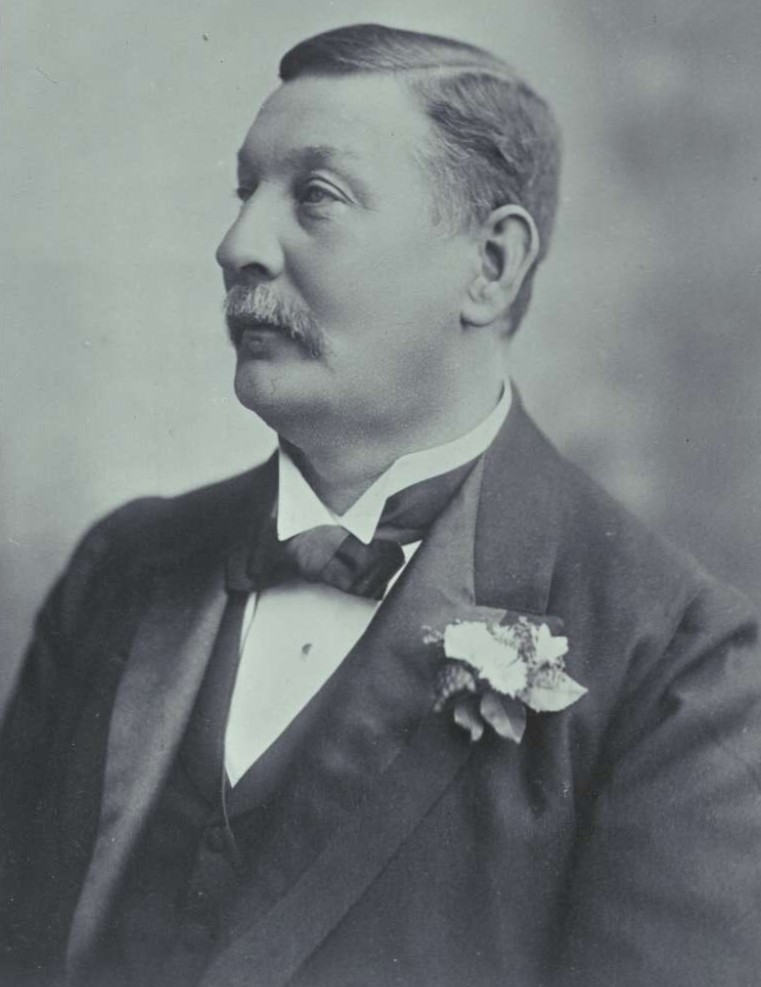
Henry Briggs via Wyman Laliberte from Edmonton, Canada · CC BY 2.0
A committed Puritan, Briggs was an influential professor at Gresham College and later Savilian Professor of Geometry at the University of Oxford.
- known_for
- Common (base 10) logarithms (Briggsian logarithms); logarithmic tables
Lore & Background
Briggs was born at Daisy Bank, Sowerby Bridge, near Halifax, Yorkshire. During this period he took an interest in navigation and astronomy, collaborating with Edward Wright. He was a friend of Christopher Heydon, a writer on astrology, though Briggs rejected astrology for religious reasons, calling it 'a mere system of groundless conceits'.
Reader's Guide
Henry Briggs's significance lies primarily in his conversion of John Napier's logarithms to base 10, producing the common logarithms that became standard for calculation for centuries. He also introduced the modern algorithm for long division. His work at Gresham College helped establish it as a hub for mathematical learning in England. The lunar crater Briggs is named in his honor. His legacy endures in the continued use of base-10 logarithms and the long division method taught in schools.
Did You Know?
- The modern long division algorithm predates Briggs and was not invented by him.
- The lunar crater Briggs is named in his honor.
Academic Journey and Institutional Influence
Henry Briggs was born on 1 February 1561 at Daisy Bank in Sowerby Bridge, near Halifax in Yorkshire. His early grounding in Latin and Greek at a local grammar school carried him to St John's College, Cambridge, where he matriculated in 1577 and took his degree in 1581. Elected a Fellow of St John's in 1588, he was appointed reader of the physical lecture established by Thomas Linacre in 1592, while also delivering portions of the mathematical lectures. During those Cambridge years he cultivated interests in navigation and astronomy, working alongside Edward Wright. In 1596 he relocated to London to assume the inaugural chair of geometry at the newly founded Gresham College, where he simultaneously taught astronomy and navigation. Over nearly twenty-three years he turned Gresham into a centre for English mathematics and actively championed the emerging ideas of Johannes Kepler. In 1619 he was named Savilian Professor of Geometry at Oxford, and he resigned his Gresham post in July 1620 to settle into his new role.
Transforming Napier's Logarithms
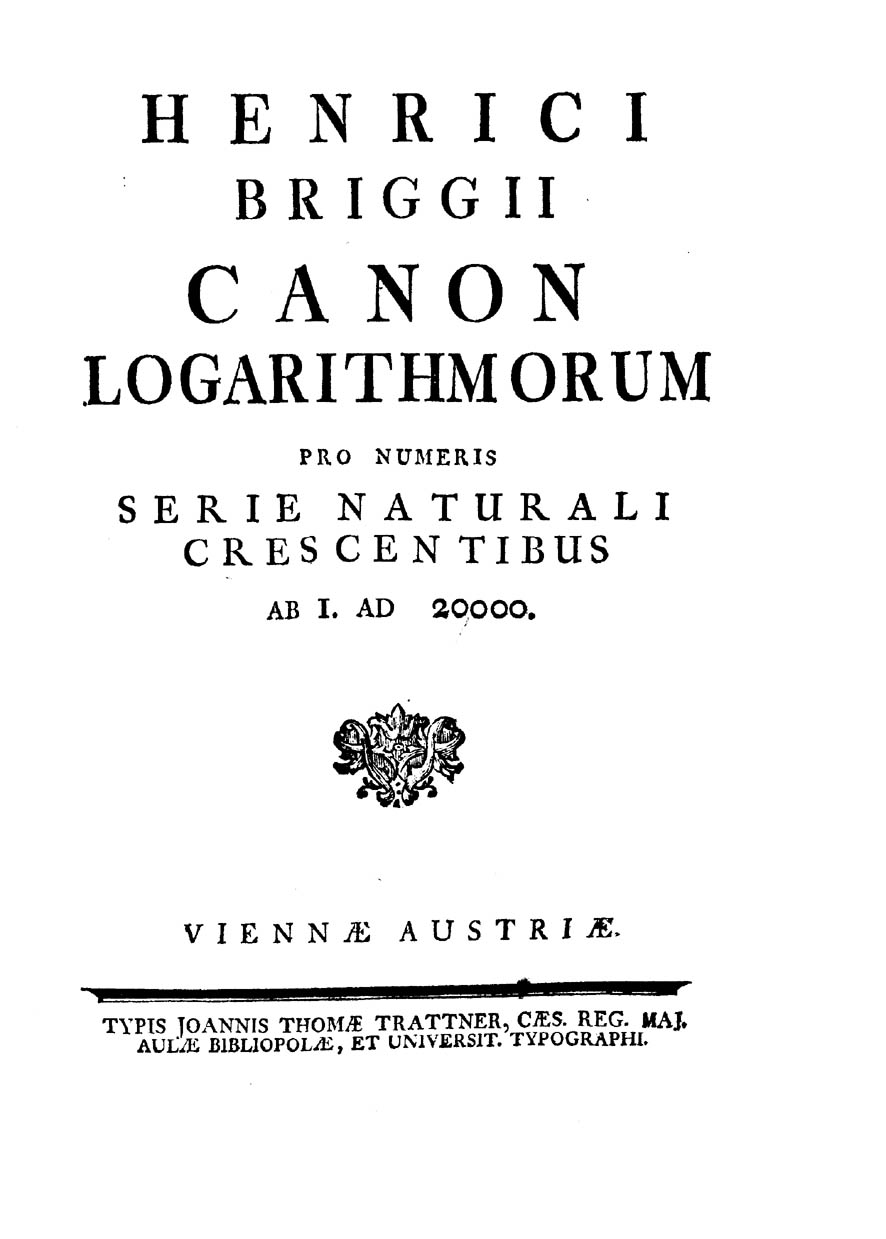
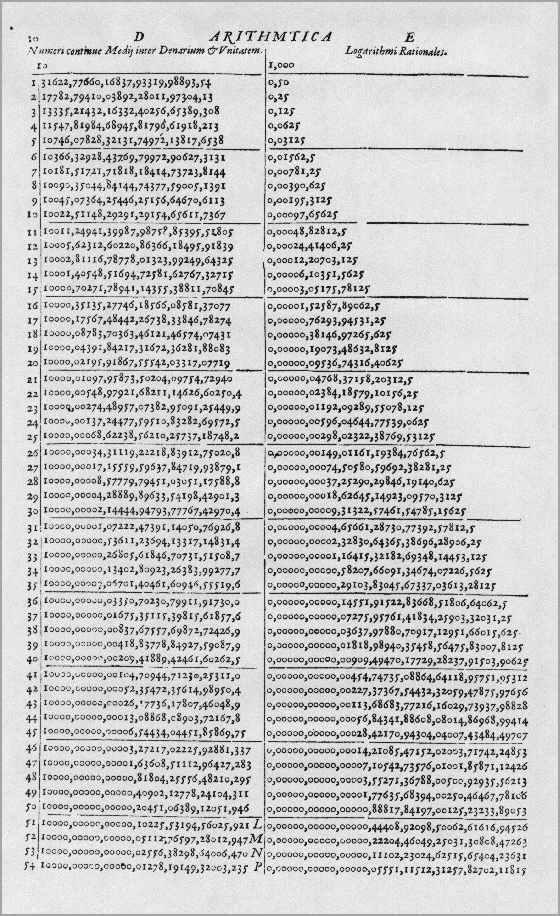
Upon obtaining a copy of Napier's Mirifici Logarithmorum Canonis Descriptio, Briggs found the original formulation cumbersome yet was deeply stimulated by the underlying concept. He envisioned a more practical system: base-10 logarithms in which the logarithm of 10 would equal 1. He presented this proposal in his Gresham College lectures and promptly wrote to Napier. In 1616 he travelled to Edinburgh to discuss the modification with the inventor, and returned the following year for further deliberation. The conferences produced a mutual agreement on the alteration. Back in England after the second visit, Briggs published the first chiliad of his logarithms in 1617, offering 14-digit common logarithms of the integers from 1 to 1000. His landmark Arithmetica Logarithmica followed in 1624 in folio format, tabulating thirty thousand natural numbers to fourteen decimal places. The remaining values were later supplied by Adriaan Vlacq. The base-10 system became so central to computation that it is still referred to as Briggsian logarithms in his honour.
Broader Mathematical Contributions and Enduring Legacy
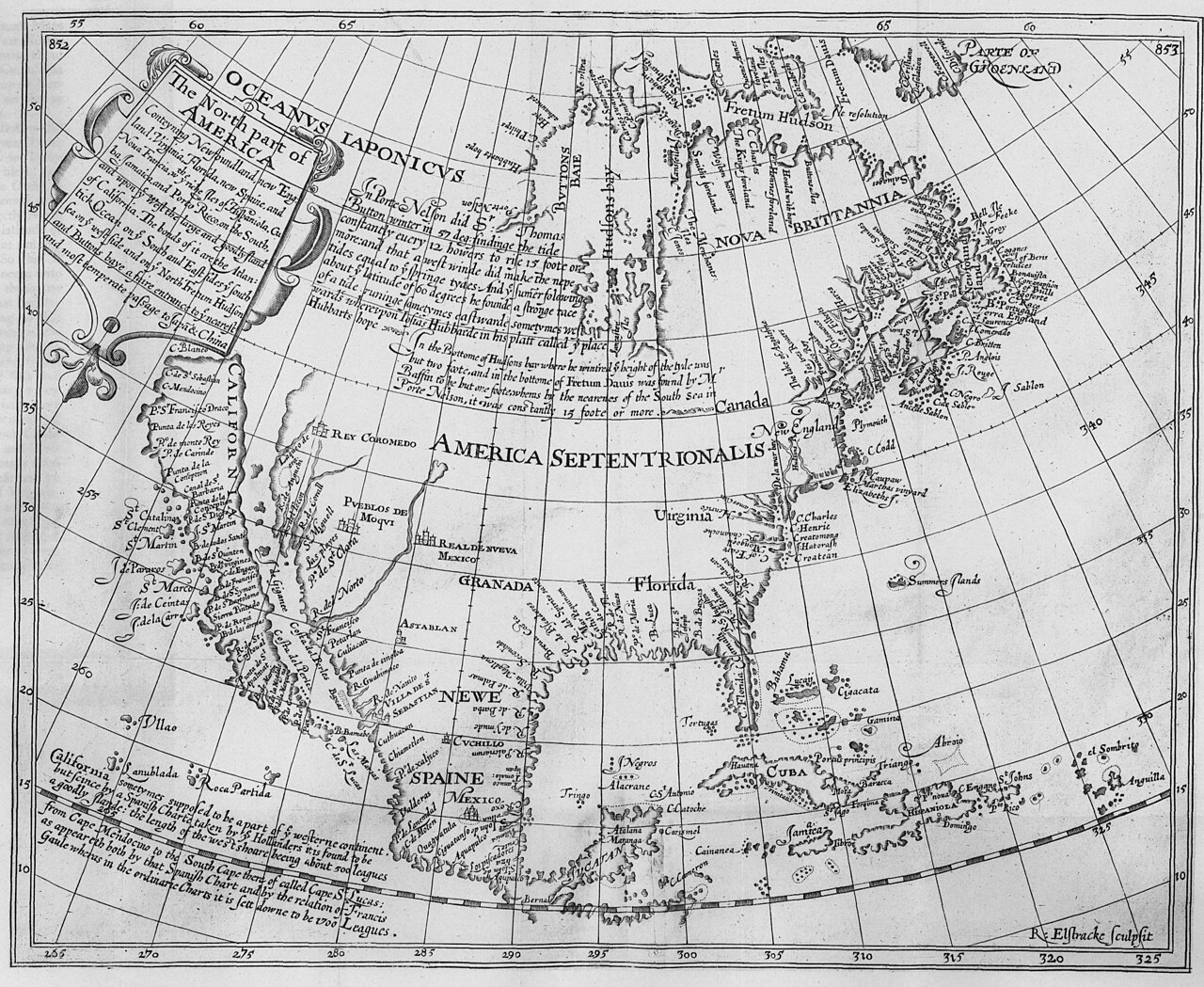
Beyond his celebrated logarithmic tables, Briggs contributed to practical mathematics in ways that persist to this day. Around 1600 he introduced the specific long-division algorithm still employed in modern arithmetic. He was also among the earliest to apply finite-difference methods for computing tables of functions. His Trigonometria Britannica, printed at Gouda in 1631 and published in 1633, provided logarithmic sines and tangents for the hundredth part of every degree to fourteen decimal places, alongside tables of natural sines to fifteen places and tangents and secants to ten. His wider bibliography spans navigation aids, a commentary on Euclid's first six books, and a 1622 tract on the Northwest Passage that inadvertently seeded the cartographic myth of the Island of California. He advised on surveying, mining, and navigation, and his influence is commemorated in the lunar crater named Briggs.
Character, Faith, and Personal Life
Briggs was a devoted Puritan whose religious convictions shaped both his intellectual stances and his private conduct. He kept a friendship with Christopher Heydon, a writer on astrology, yet firmly rejected the practice on theological grounds, dismissing it as a mere system of groundless conceits. Dr. Smith, in his Lives of the Gresham Professors, portrayed Briggs as a man of great probity who condemned the pursuit of riches and preferred a studious retirement over the splendid circumstances of life. In 1619 he invested in the London Company, and his household included two sons: Henry, who later emigrated to Virginia, and Thomas, who stayed in England. Briggs died on 26 January 1630 and was interred in the chapel of Merton College, Oxford. His life, spanning nearly seven decades, carried him from a Yorkshire village to the very heart of English mathematical learning, leaving a body of work that fundamentally reshaped how the world performed calculation.
Gallery
Frequently Asked Questions
What is Henry Briggs (mathematician) known for?
He developed common (base 10) logarithms, often called Briggsian logarithms, and produced the logarithmic tables that spread the method across Europe. His work turned an abstract mathematical invention into a hands-on tool for engineers, navigators, and astronomers.
Why is Henry Briggs (mathematician) important?
By anchoring logarithms to base 10, he made them dramatically easier to compute and look up, which accelerated scientific and commercial calculation for generations. His tables became a standard reference in navigation, astronomy, and engineering well into the eighteenth century.
What is the connection between Henry Briggs (mathematician) and John Napier?
Napier originally devised logarithms using a non-decimal base, and Briggs recognized that a base-10 version would be far more useful in practice. The two collaborated closely, with Briggs computing the tables that carried Napier's idea into widespread everyday use.
More in Mathematicians 25-36
Elsewhere in the Mathematicians universe
Spotted an error? Know more?
This is a living reference — every entry is fact-audited, and reader corrections feed straight into our audit queue. Suggest an edit · See this site's audit record